Chapter 8: Choosing AI-Compatible Technology Stacks
Very new technology stacks are hard for AI to master, because training data is too limited... The word 'compatibility' gains a new meaning in this context.
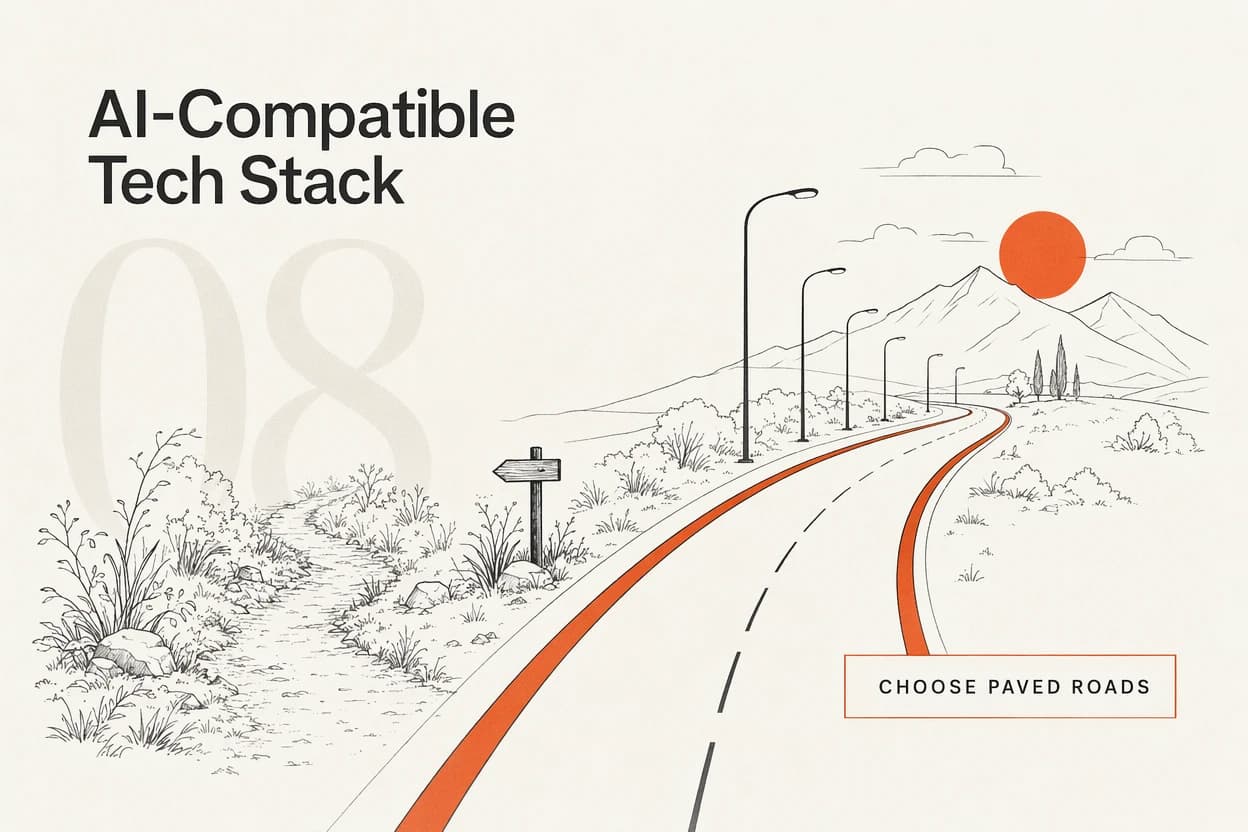
"Very new technology stacks are hard for AI to master, because training data is too limited... The word 'compatibility' gains a new meaning in this context."
Extended reading: How small teams can leverage AI-compatible stacks more effectively, see The Structural Advantages of AI-Native Small Teams. For how conventions work with tech stack choices, see Conventions and Development Standards: Let AI Dance in Chains.
1. "AI compatibility" is a new kind of compatibility
Traditionally, when we talk about "compatibility," we mean:
- Browser compatibility
- Platform compatibility
- Third-party library API compatibility
In the AI-native era, there's another layer:
- Is the technology stack friendly to AI?
- Does AI have enough training data and practical samples on this stack?
"Very new technology stacks are hard for AI to master, because training data is too limited, for example Deno;
But if it's mature like Next.js, AI can quickly produce correct code."
This means:
- Technology selection is no longer just a game of "performance, ecosystem, stability"
- You also need to consider: "How much work can AI help with on this stack?"
2. Choosing mature stacks is to let AI do more
If you choose a very new stack with a still-thin ecosystem:
- Documentation is incomplete, community practice samples are few
- Code samples in training data are also few
- AI's "proficiency" on this stack will be noticeably low
Conversely, if you choose a stack that's been validated by massive projects:
- Various typical usages, best practices, anti-patterns, AI has "seen many times"
- When you ask it to write code, write tests, refactor, success rate will be much higher
- You can put more energy into business and workflow design, rather than struggling with the stack itself
This is the practical meaning of "AI compatibility":
- Not that new stacks aren't worth attention
- But when your team has limited people and strongly depends on AI productivity,
choosing a stack AI is very familiar with is often more cost-effective.

3. Practical decision recommendations
In a two-person small team, strongly dependent on AI, you can use a relatively simple set of decision principles:
Prioritize stacks AI is very familiar with
- Web frontend: Next.js / React / Tailwind / common UI libraries
- Backend: Node/TypeScript + Postgres, or mature serverless combinations
Prioritize AST / symbol-friendly languages and toolchains
- Convenient for AI IDEs and CLI tools to do intelligent refactoring, navigation, and test generation
Consciously avoid overly 'pioneering' technology combinations
- If a stack is still in the "trial period" in the community, AI probably can't help much
Technology selection is always a trade-off, but in the AI-native world,
if you want AI to truly become a team member, the technology stack must be friendly to AI.
Get new articles by email
One email when a new article lands. Nothing else.