Chapter 9: Five Levels of AI Coding and the User Story Driven Endgame
Vibe Coding only describes a very primitive stage. The endgame should be user-story-driven development.
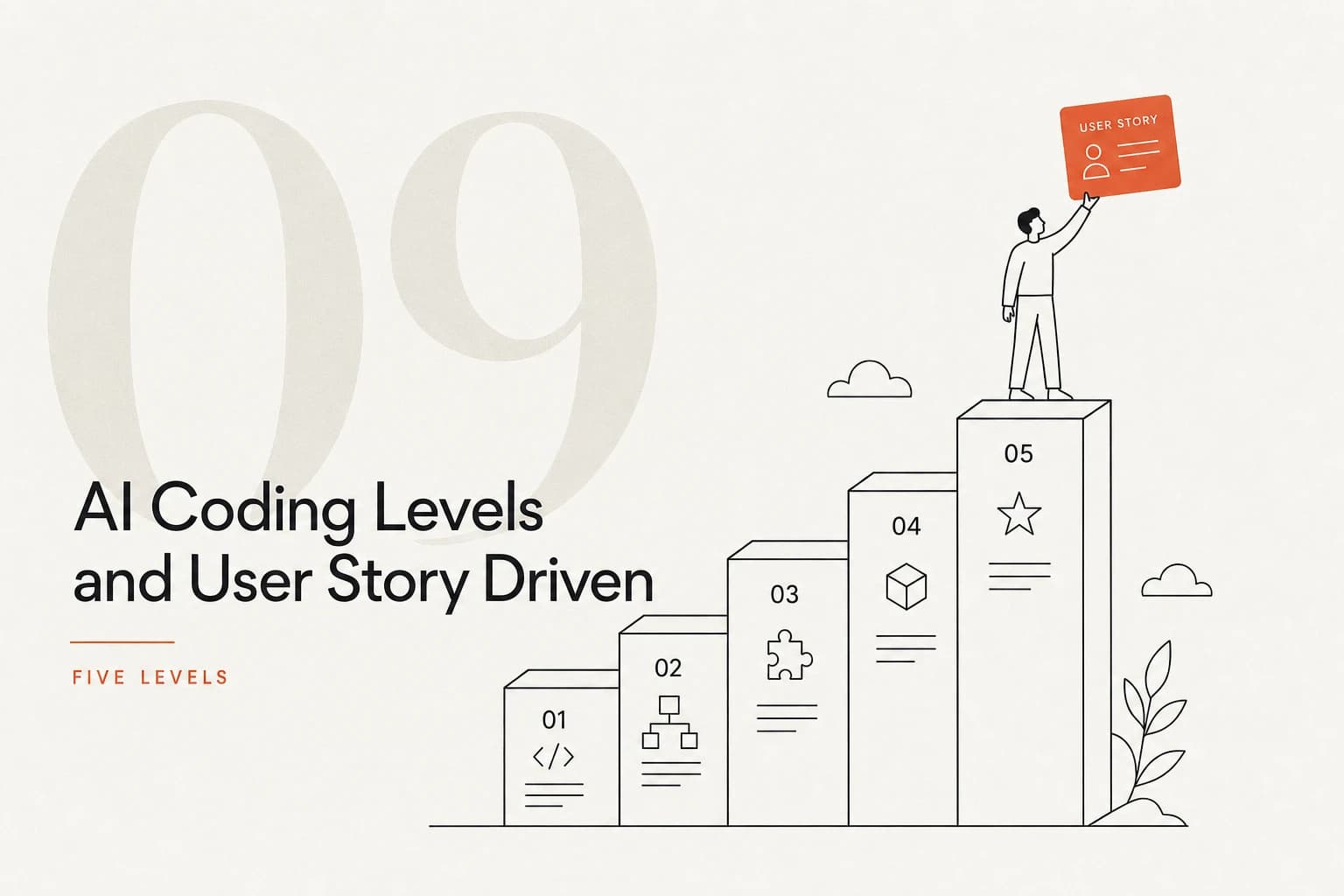
"Vibe Coding only describes a very primitive stage. The endgame should be user-story-driven development."
Extended reading: How user stories enable horizontal complexity transformation, see From Vertical to Horizontal Complexity. For the complete knowledge workflow that connects user stories to code, see Meeting Recording→PRD→TDD→Code: AI-Native Team's Knowledge Workflow.
1. From Vibe Coding to machine manager
Today, many people using AI IDEs (like Cursor) stay at a very primitive stage:
- Think of something and type a paragraph in Chinese
- Have AI help "do this requirement"
- Look at the effect, roughly works is fine
This is so-called Vibe Coding:
More of a feeling-based, unclear-boundary, unstructured way of using it.
But if you extend the timeline, you'll find AI coding users actually have a very clear "rank evolution path":
"At the beginner level, the programmer is still thinking like a human.
At the intermediate level, the programmer starts thinking like a machine.
At the advanced level, the programmer becomes a manager of machines."
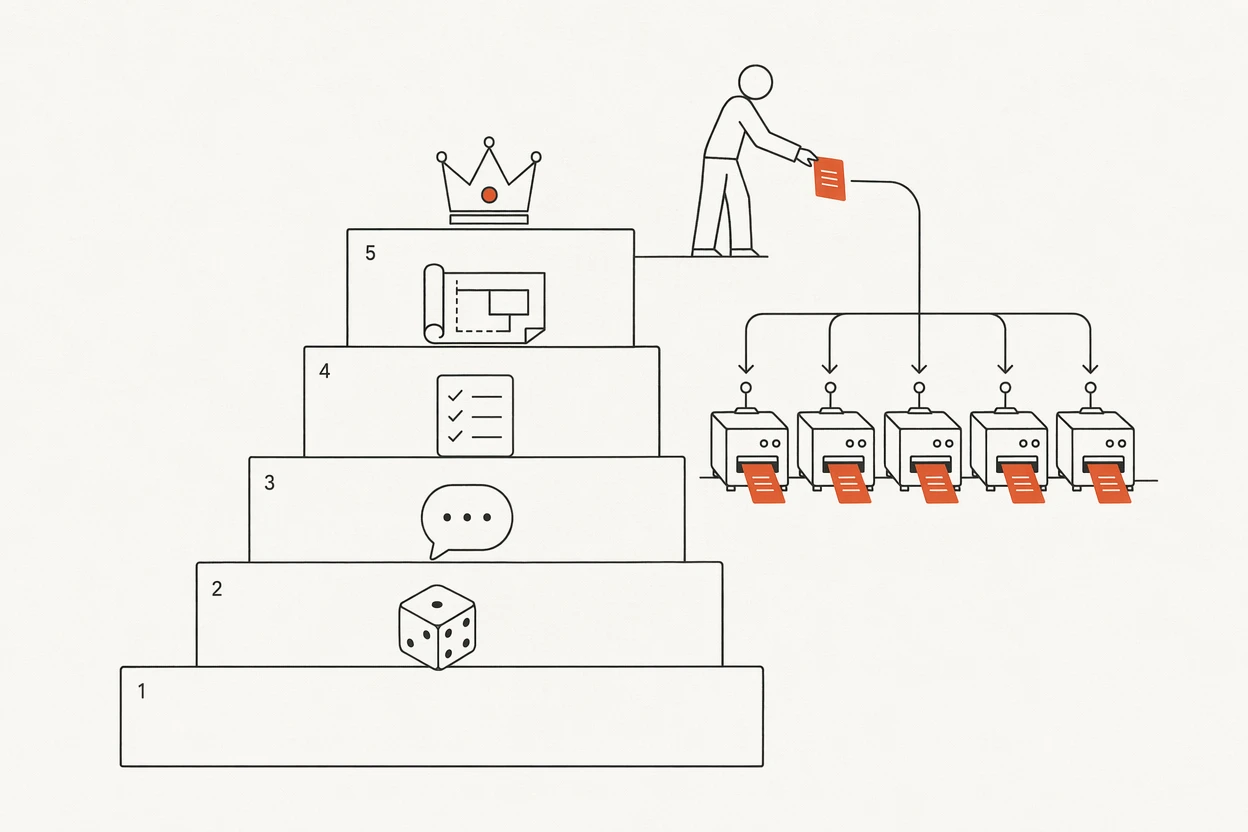
2. Five levels of AI coding users
A relatively clear classification can be:
Inexperienced AI Coding Users
- Use Chinese, aimless, think of something and do it
- Don't realize context window is limited
- Don't realize AI IDE hasn't read your entire codebase
Proficient AI Coding Users
- Realize they should use English
- Realize context window is limited
- Realize Cursor doesn't read your file's full text, but does fragment retrieval
Users Who Have Solidified Their Own Workflows
- Have a stable prompt pattern and workflow
- Can quickly apply their own Cursor rules, command-line tools, templates
Issue Tracker Level Users
- Use MCP, Issue Tracker, and other tools, treating "one issue / one requirement" as the core unit of collaboration
- Can simulate a complete team collaboration flow around one issue (requirement → design → development → testing)
User Story Driven AI-Native Teams
- The entire system is completely transformed to AI-Native:
- User story is a first-class citizen
- AI can work asynchronously and in parallel
- Can have 100 user stories in different stages progressing in parallel simultaneously
- The entire system is completely transformed to AI-Native:
3. Why the endgame must be User Story Driven
From an engineering perspective, User Story Driven has several natural advantages. A user story is a natural segmentation unit: it comes with context, expected behavior, and acceptance criteria, making it very suitable as an AI work unit. It is also a natural test carrier: in ideal state, one user story = one set of end-to-end tests, which has been explicitly proposed in the story-ops exploration. And it is naturally suited for horizontal complexity: each story is a relatively independent shallow chain, which fits well with the idea of "complexity from vertical to horizontal" (see From Vertical to Horizontal Complexity for details).
When teams truly reach the User Story Driven stage:
- The subject between product, design, engineering, and testing all becomes "story"
- AI doesn't directly operate on "code," but operates on "the complete lifecycle of a story"
- Code, documentation, and tests all become derivatives of stories
4. How to level up from where you are today
In reality, you don't need to rush to level 5 from the start. You can first ask yourself a question:
"What level of AI coding am I at today?
What can I do next to level up?"
Some practical upgrade paths:
From 1 → 2:
- Switch to English
- Explicitly consider context window size and content selection
From 2 → 3:
- Solidify frequent operations into documents, templates, commands
- Have AI read these rules first, then start working
From 3 → 4:
- Organize work by issue
- For each issue, be clear: what's the input, what's the output, what's the verification method
From 4 → 5:
- Further abstract issues into user stories
- Try to achieve: one story comes with PRD + TDD + test cases
- Use tools (like future story-ops) to make story the main entry point for all roles
The AI-Native endgame isn't some cool tool, but a new collaboration method "with user story as the atomic unit."
From Vibe Coding to User Story Driven is a growth curve about "how to collaborate with AI."
Get new articles by email
One email when a new article lands. Nothing else.