Chapter 10: The Structural Advantages of AI-Native Small Teams
An era when small teams can win... We carry no baggage, so we can rebuild productivity across every step of how we work, as thoroughly as we like.
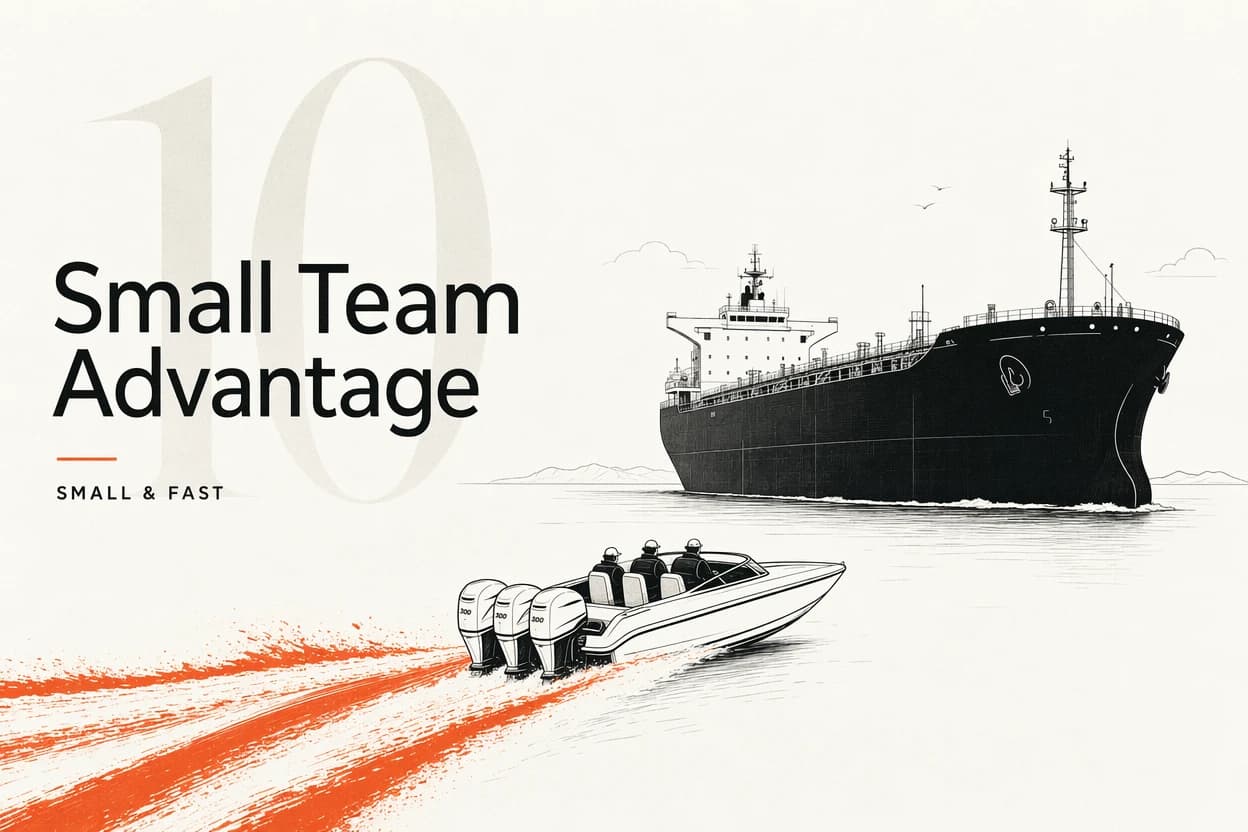
"This is an era when small teams can win... We carry no baggage, so we can rebuild productivity across every step of how we work, as thoroughly as we like."
Further reading: on how conventions keep a small team stable, see Conventions and Development Standards: Let AI Dance in Chains. For the full knowledge workflow pipeline a small team can run, see Meeting Recording→PRD→TDD→Code: AI-Native Team's Knowledge Workflow.
1. Big companies vs. small teams: who has the easier path to AI-Native
On paper, big companies look better positioned for AI transformation. They have more money, more people, more infrastructure.
In practice, going AI-Native tilts toward the small team:
- A big company sits on years of legacy systems and processes that nobody can rebuild wholesale
- Its processes, standards, and sign-off chains were all designed around humans writing the code
- Even when AI does come in, it usually lands as a modest upgrade to a handful of steps
"A big company with 100 steps in its workflow will overhaul maybe 10 of them.
A small team like ours is different. We carry no baggage, so we can rebuild productivity across every step, as thoroughly as we like."
2. Bring AI into all 100 steps and the gains multiply
Break a complete software engineering process apart and you can easily list dozens, even a hundred, distinct steps:
- Requirements interviews, PRDs, design reviews
- Architecture, technology choices, database schema design
- Coding, integration, testing, deployment
- Log analysis, alerting, incident debugging, postmortem writeups
- ...and so on
The conventional transformation playbook goes like this:
- A big company picks 5 to 10 of these steps and accelerates them with AI
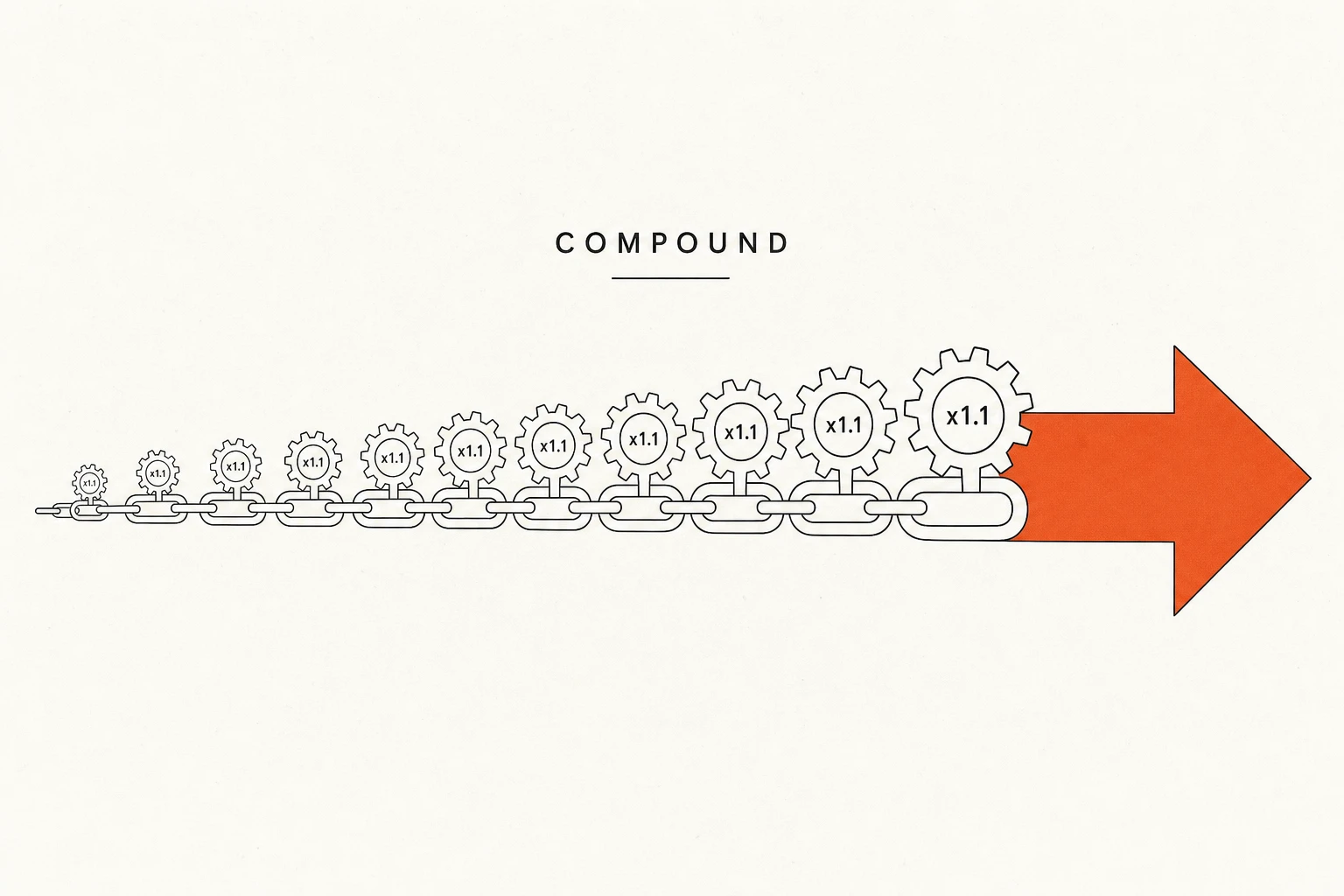
- Each one gets a little faster, and the total effect is additive
A small team can do something a big company finds nearly impossible:
- Assume from day one that all 100 steps can be rebuilt around AI
- Refuse to presuppose that "this step has to stay human, that step can never go to AI"
- Apply one consistent AI-Native design approach and connect every step into a single chain
Once all 100 steps have been redesigned, the overall gain stops behaving like a sum. It behaves like several rounds of compounding multiplication.
3. Fewer people means you need AI more, and can push it further
One direct consequence of AI: each person produces more, and teams get smaller. For a small team this is actually good news:
- With few people, there is no elaborate org structure to fight
- A new process, a new convention, a new workflow can spread to the whole team in days
- Nobody has to push an AI tool through layers of management and review before anyone gets to use it
At the same time, being small cuts the other way:
- You have no spare hands for large amounts of repetitive work
- So you have every incentive to push AI as far as it will go at each step
- That includes the kind of thing this manifesto itself is doing: using AI to organize workflows, assemble chapters, and turn working habits into written methodology
4. The heavier the constraints, the steadier a small team runs
There is another point that matters a great deal in an AI-Native team:
"Conventions and development standards matter even more for an AI-Native team... Let AI dance in chains."
This holds especially well for small teams:
- At the very start of a project, you can lay down constraints in bulk: naming rules, directory structure, testing conventions, documentation formats
- AI is boxed in by those constraints from day one and can only dance inside the permitted space
- That slows down the rate at which entropy builds up in the system, by a lot
For a big company, retrofitting constraints like these onto existing systems is enormously expensive. A small team gets them almost for free by simply starting out that way.
5. Wrapping up: AI-Native is the small team's window
Put together, AI-Native does not play out as a Matthew effect where the strong just get stronger. It hands small teams a new window of opportunity:
- Big companies struggle to rebuild wholesale, so they upgrade locally
- A small team can reshape all 100 steps the AI-Native way from the start
- Once every step has been redesigned, its overall throughput will far outrun a big company that only sprinkled AI on a few spots
None of this guarantees that small teams win. But it does mean:
- In this era, small teams no longer start from a built-in resource disadvantage
- As long as they are willing to go all in on AI across their processes and workflows,
- they have a real shot at doing, with very few people and in very little time, work that used to take an entire large organization.
Get new articles by email
One email when a new article lands. Nothing else.