Part Four: The Binary Future of Efficiency and Experience, a Quantitative Projection of the Next Socio-Economic Model
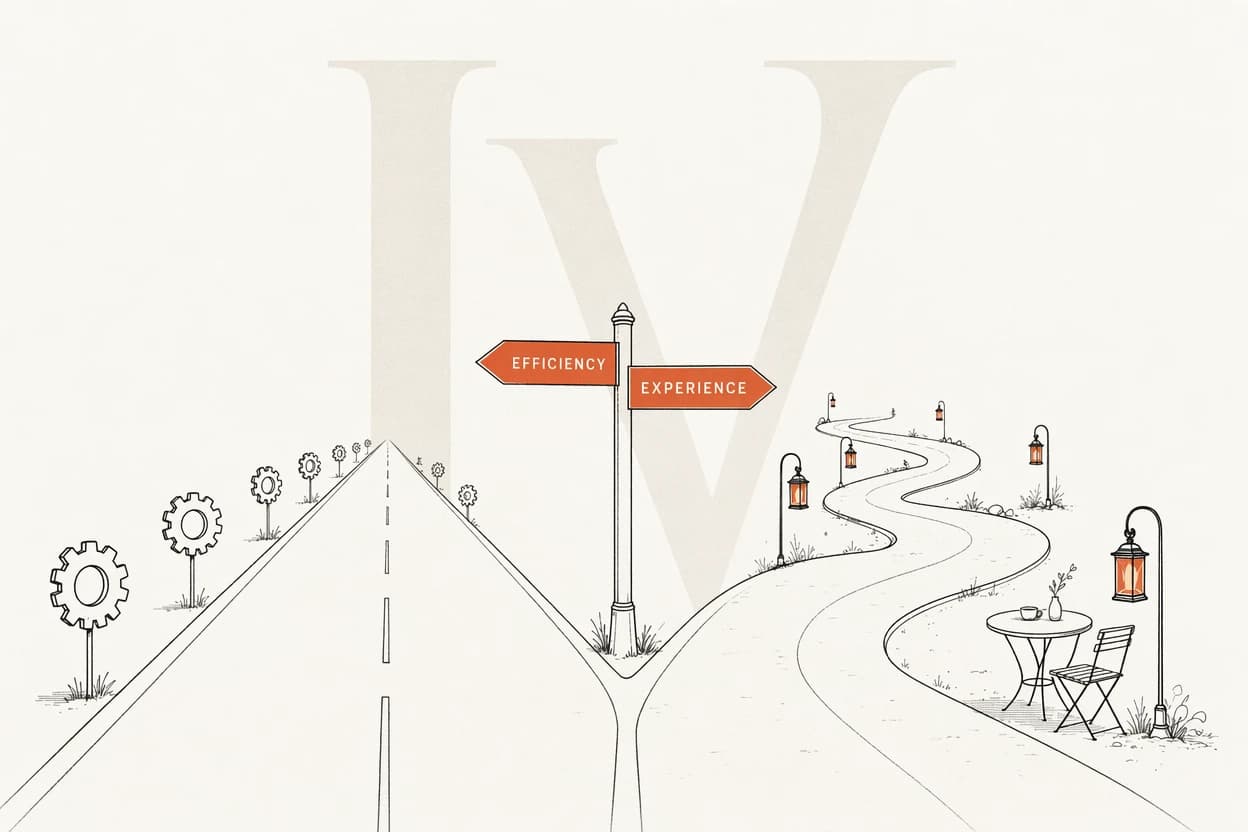
The economy is running toward two extremes: maximum efficiency or maximum experience. The stuck-in-the-middle ground between them is quietly disappearing.
(This is the fourth article in the series, "From Rural Towns to the Global Economy: A Thought Experiment on an Economic Model." Please stay tuned for subsequent articles.)
In the first three articles, we began by taking apart the economic pulse of a small American town, found a theoretical key called "tradable/non-tradable," and used it to dissect global economic divisions and historical evolution. We found that the progress of the human economy is mostly a process of continuously strengthening the "tradable sector" (the engine) and allowing its wealth to spill over.
Now, with this key in hand, we will push open the door to the future. When artificial intelligence and automation boost the engine's horsepower to its absolute maximum, what kind of socio-economic form will emerge? This article tries a bold but careful quantitative projection.
Introduction: standing at the crossroads of abundance
We are living through a big change. As of September 2025, the wave of artificial intelligence is sweeping the globe at a remarkable speed, and automation technology is moving from factory assembly lines into every part of our lives. All of this points to a future of enormous productivity and abundance.
Alongside that technological optimism sits a deep and widespread anxiety. When machines can do almost all standardized work, what is the value of us humans? Will there be enough jobs in the future? Is this AI-driven future a path to a utopia of shared prosperity, or a dark cyberpunk world of mass unemployment?
The answer may be neither.
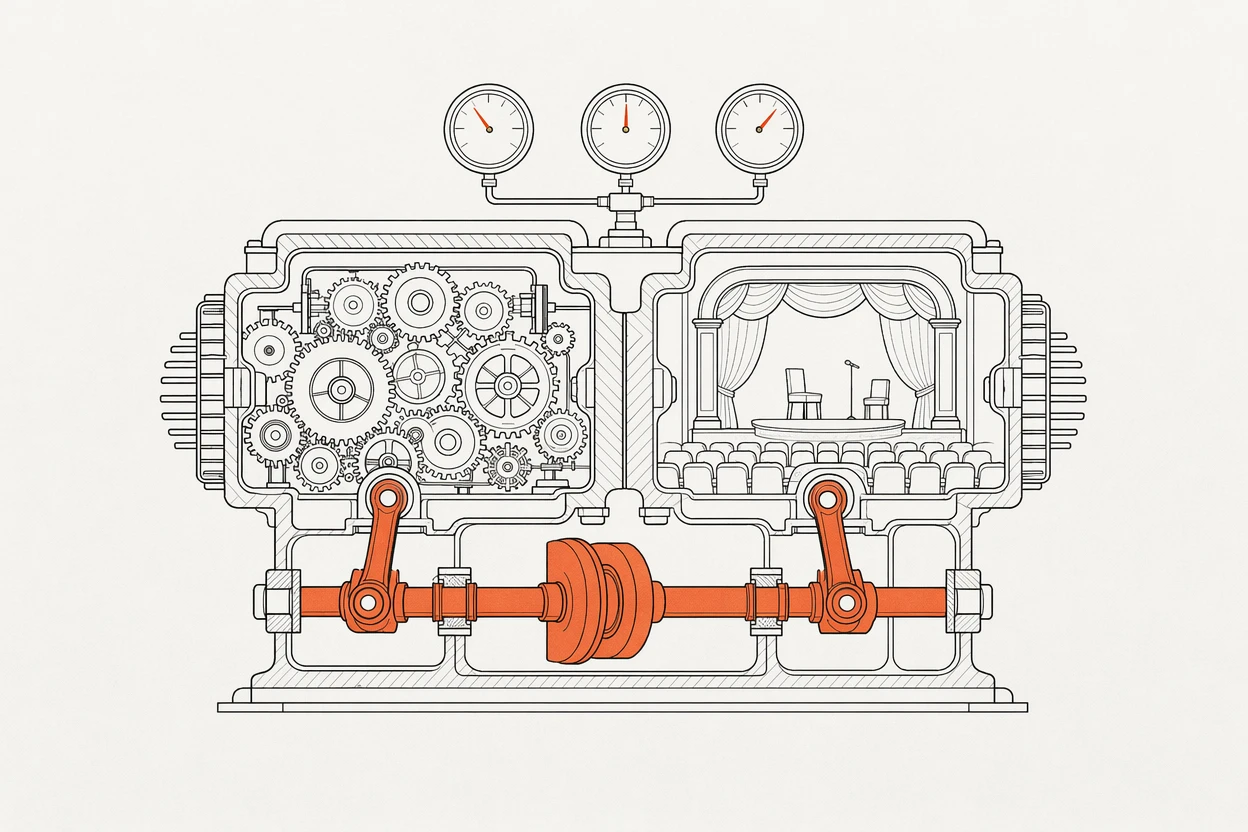
Based on the economic framework we have built, a more probable and logical vision of the future is taking shape. It is not a single destination but a path toward a polarized "Binary Future." In this future, old industrial classifications will lose their meaning, and the whole socio-economic landscape will be restructured into two coexisting, very different new sectors. One pursues the ultimate in "Utility & Efficiency," and the other provides the ultimate in "Experience & Humanity."
This article runs a systematic, quantitative projection of that binary future and sketches a clear blueprint for the next generation's socio-economic model.
Chapter 1: the great divergence, the birth of two new economic sectors
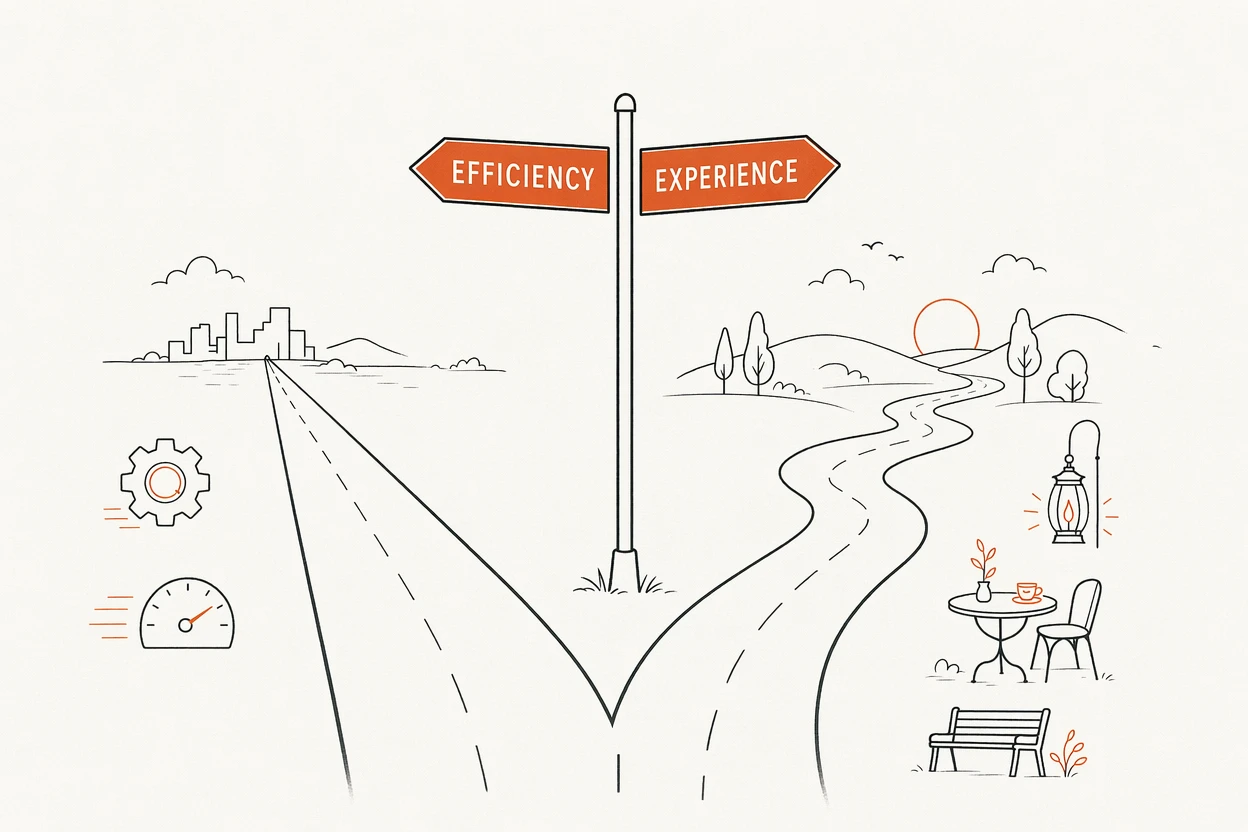
Future economic competition will no longer be a uniform race to the bottom. It will be an "evolution" toward two extreme poles. The "middle ground," with its mediocre prices, passable quality, and average service, will get squeezed out of existence.
1. Why the "middle ground" is doomed
Picture an ordinary department store. On price and convenience, it cannot compete with an AI-driven, fully automated e-commerce platform. On experience and expertise, it cannot match a carefully curated brand flagship store staffed by expert advisors. It has no advantage on the efficiency battlefield or the experience one, so its end is inevitable. The same logic applies across all industries. Businesses and individuals have to choose: become a king of efficiency or a master of experience.
2. The Utility & Efficiency track
The core objective here is to meet all of humanity's basic, functional needs at the lowest possible cost in time, money, and effort. The driving forces are artificial general intelligence, automation, robotics, big data, and economies of scale. The goal is to make acquiring the basic materials for life "as natural as breathing and as cheap as air." It works like an invisible, highly efficient "planetary-scale operating system" that quietly keeps the whole society running.
3. The Experience & Human-Centric track
The core objective here is to meet the higher-level needs for emotion, growth, connection, and self-actualization that surface once humanity's survival needs are met. The driving forces are human creativity, empathy, craftsmanship, intellectual depth, and emotional communication. This track is the central stage for humanity's spiritual life. It offers not standardized "products" but personalized "experiences," human-to-human "connections," and warm "care."
Chapter 2: glimpses of the future, binary trends across industries
This binary divergence might seem distant, but it is already visible in today's business trends.
| Industry | The "Utility & Efficiency" Future | Current Trends | The "Experience & Human-Centric" Future | Current Trends |
|---|---|---|---|---|
| Retail | AI-powered predictive auto-refill, automated warehouses + drone delivery, making the process of obtaining necessities completely "frictionless." | Amazon "Subscribe & Save," warehouse clubs (Costco), unmanned convenience stores (Amazon Go). | Physical stores become brand experience centers, community social spaces, and lifestyle curation venues, with staff acting as expert consultants. | Apple Retail Stores, NIO Houses, various curated fashion boutiques and brand concept stores. |
| Transportation | Subscription to "Mobility-as-a-Service," with AI-dispatched fleets of autonomous shared vehicles providing lowest-cost point-to-point commuting. | Uber/Lyft, Tesla FSD, Waymo, shared city e-bikes. | The "journey" itself becomes the product, with people paying for meticulously designed luxury train trips, themed expeditions, etc. | The revival of luxury trains like the Orient Express, high-end bespoke travel, private jet services. |
| Healthcare | AI provides 24/7 health monitoring and early diagnosis, standardized surgeries are performed by robots, and pharmaceuticals are delivered by drones. | Apple Watch health monitoring, AI-powered medical imaging diagnostics, telehealth, Amazon Pharmacy. | Private health concierge teams (doctors, nutritionists, therapists) provide deep, holistic, and caring health management. | The rise of "concierge medicine," high-end wellness centers, and the boom in therapy and personal coaching. |
| Education | AI-adaptive platforms handle the most efficient instruction of all standardized knowledge (math, science, languages). | Khan Academy, Duolingo, and various AI-powered educational software platforms. | Human teachers transition to become mentors of the mind, focusing on inspiring creativity and humanistic literacy through small-group, project-based seminars. | "Flipped classrooms," project-based learning (PBL), and innovative workshops emphasizing mentorship. |
| Entertainment | AI algorithms generate an endless stream of personalized content (short videos, music, news) to fill all fragmented time. | TikTok/Reels "For You" feeds, Spotify's algorithmic recommendations, AI-generated music and articles. | A return to live events, community, and a "handcrafted" feel. People pay for premier live performances, in-depth podcasts, indie games, and films. | The vinyl record revival, success of indie film studios like A24, record-high ticket prices for live music and sports. |
Chapter 3: blueprint for the future, a quantitative model of the new world economy
Let's build a complete, self-consistent quantitative model for this binary future society.
1. Macro-level assumptions
The model assumes a global population of 9 billion and a global labor force of 4 billion. GDP per capita is $28,000, double the current level. That puts Global World Product (GWP) at $252 Trillion.
2. Analysis of the restaurant industry (a case study for the model)
Take the restaurant industry as an example to see how the binary model works. Experience Dining serves 2.4 billion relatively affluent people, with an annual output of $18 trillion, providing 270 million labor-intensive jobs. Efficiency Food Service serves 5.8 billion price-sensitive people, with an annual output of $5.8 trillion, requiring only 18 million technology-intensive jobs. The industry total comes to $23.8 trillion (9.4% of GWP) and 288 million jobs. Feeding ourselves, for the first time in history, takes up less than a tenth of humanity's total ledger.
3. A blueprint for the restructuring of global employment and income
Extending this logic to the entire global workforce of 4 billion, we get a completely new social structure:
| The "Utility & Efficiency" Sector | The "Experience & Human-Centric" Sector | |
|---|---|---|
| Share of Labor Force | 20% (800 million people) | 80% (3.2 billion people) |
| Average Annual Salary | $157,500 | $39,375 |
| GDP Created | $126 Trillion (50% of GWP) | $126 Trillion (50% of GWP) |
Internal salary tier breakdown:
Within the Efficiency Sector (Avg. $157,500), the top tier (10%) handles core R&D and strategy at an average salary of $400,000 (e.g., AI architects, fusion scientists). The mid tier (40%) covers engineering, design, and management at $170,000 (e.g., robotics engineers, supply chain optimizers). The base tier (50%) runs operations, maintenance, and tech support at $99,000 (e.g., AI farm monitors, fleet maintenance technicians).
Within the Experience Sector (Avg. $39,375), the top tier (5%) is top creators and masters at $180,000 (e.g., Michelin chefs, renowned artists, top-tier mentors). The upper-mid tier (25%) is professional services and high-skilled artisans at $53,500 (e.g., senior teachers, psychotherapists, architects). The core tier (50%) is frontline service professionals at $28,000 (e.g., restaurant servers, fitness coaches, community teachers). The base tier (20%) is auxiliary and community services at $15,000 (e.g., community gardeners, event assistants).
Chapter 4: testing the model's viability, a "stress test" for the future economy
This model may look appealing, but is it economically sound?
Income distribution test (Gini coefficient):
In this model, the 20% of the population working in the Efficiency Sector earns 50% of total national income. Looking only at the gap between the two sectors, the Gini coefficient works out to roughly 0.30; counting the tiers within each sector pushes it somewhat higher, but the disparity would still be far lower than in the United States today, closer to Nordic welfare states. What matters is that the Experience Sector provides a very high income floor for the general population, which prevents mass poverty. The model holds up.Labor productivity test:
The Efficiency Sector creates 50% of GDP with 20% of the labor force, while the Experience Sector creates the other 50% with 80% of the labor force. Run the math and per-capita labor productivity in the former works out to 4 times that of the latter. That matches the real-world gap between capital and technology-intensive industries and labor-intensive ones. The model holds up.Consumption structure test (Engel's Law):
The model predicts that as society becomes extremely affluent, people will spend a larger share of income (65%) on non-essential, experience-based consumption. That lines up with Engel's Law and the economics of consumption upgrading. The model holds up.Human capital test (the challenge of education):
The biggest constraint on whether this model can be realized is education. Society has to cultivate 800 million people with top-tier STEM skills and 3.2 billion people with deep empathy, creativity, and humanistic literacy. That demands a full overhaul of our current "factory-style" education system. The model is logically sound, but it asks an enormous amount of society.
Conclusion: the dawn of a post-scarcity era
Through quantitative projection and careful analysis, we have sketched a future that is not as distant as it may seem.
By pushing the Efficiency Sector to its limit, this binary society solves the problem of "material scarcity" for the first time in human history, a basic constraint that has weighed on us for tens of thousands of years. Acquiring the basic goods needed for survival becomes cheaper and more convenient than ever.
The vast majority of the workforce, freed up by that shift, will move into a huge new era of the "experience economy." The focus of human work moves away from a struggle against nature and machines toward service, connection, and resonance between people.
This points to a deep social shift. Our challenge will no longer be how to allocate scarce resources, but how to find meaningful lives and dignified work for everyone in a world of material abundance.
The path from today's contradictory reality to that brighter future still runs through a deep valley full of thorns and obstacles. In the final article, we will look at that difficult transition: the painful stretch we'll call "The Great Mismatch Era."