Part Three: From the Metropolis to the Planet, a Picture of the Global Division of Labor Under a Single Framework
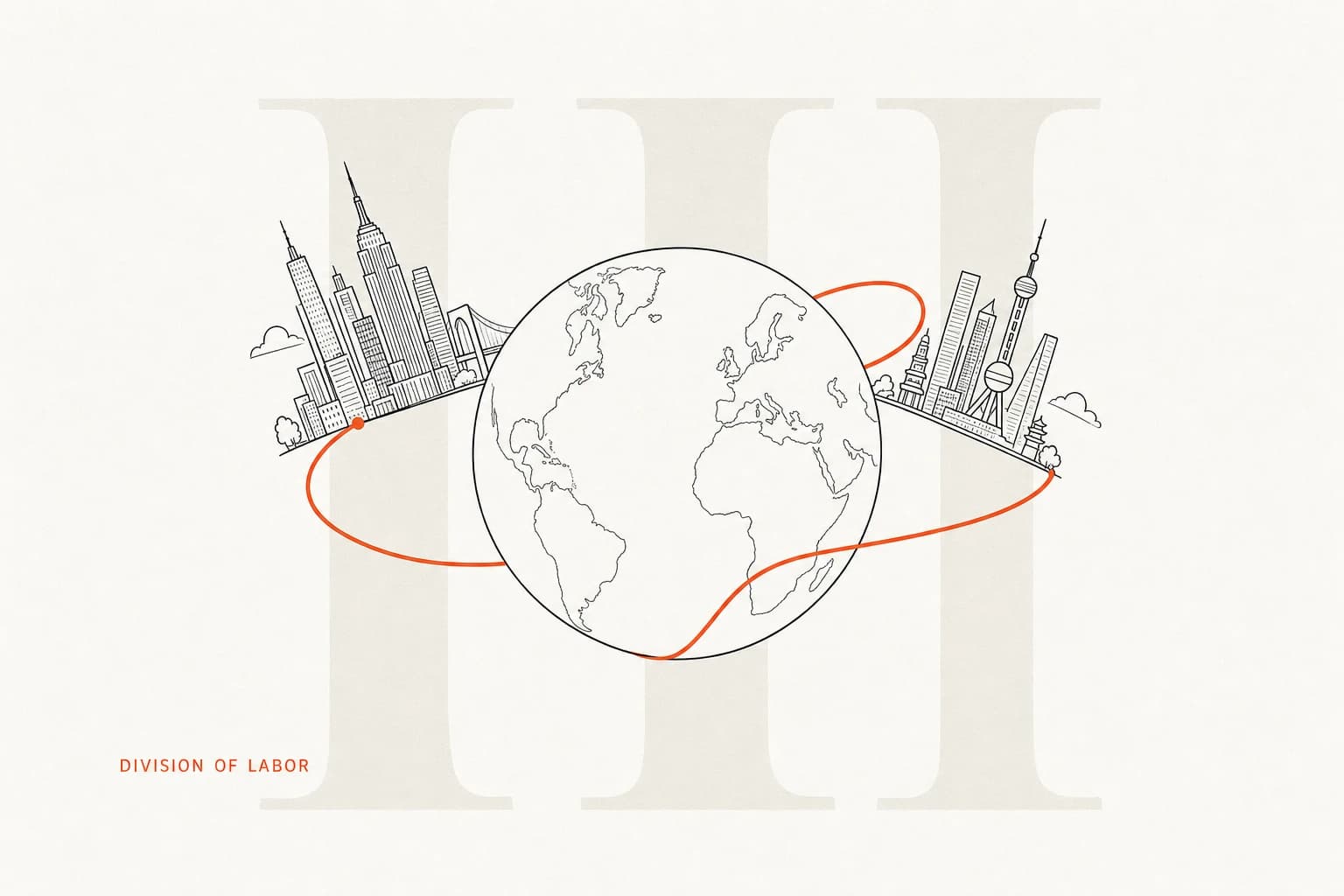
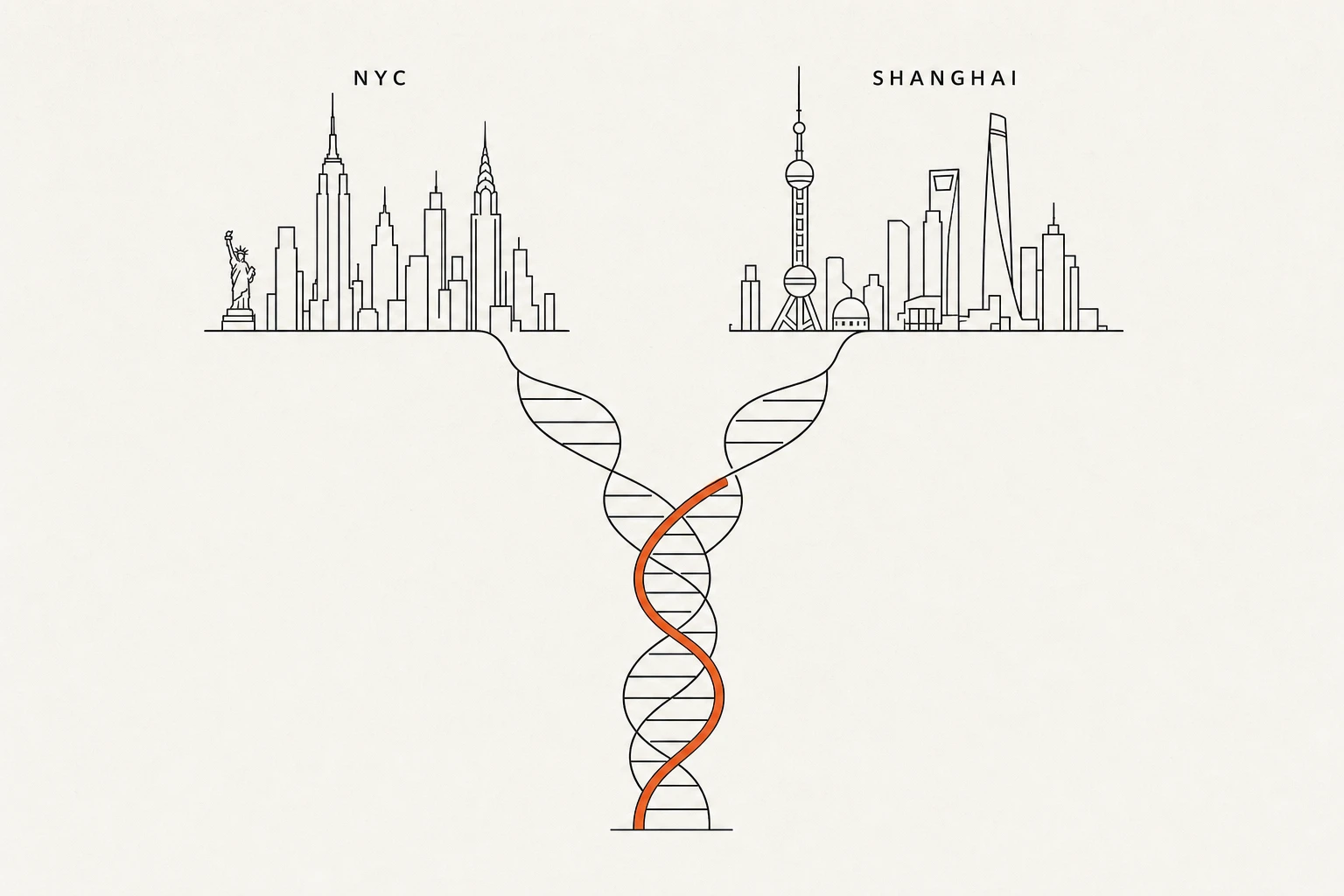
New York and Shanghai look more alike on the surface every year. Put them under the tradable/non-tradable X-ray, though, and their economic DNA turns out to be nothing alike.
(This is the third article in the series, "From Rural Towns to the Global Economy: A Thought Experiment on an Economic Model." Please stay tuned for subsequent articles.)
In the last article, we found a "master key" to unlock the puzzle of the global economy: the framework of "tradable" versus "non-tradable" sectors. We came to understand that a region's prosperity is determined by the productivity of its tradable sector (the engine), which in turn anchors the overall wage and price levels of its local non-tradable sector (the hull).
Now it is time to test what this key can really do. In this article we will use one analytical framework to open three heavy doors. Behind the first door lies the economic DNA of the world's two leading megacities, New York and Shanghai. Behind the second is a macro-level map of the division of labor among all of humanity's 3.6 billion workers. Behind the third lies the dust of history, where we will see why our ancestors were trapped in a millennium of economic stagnation.
Are you ready? Let's begin this exploration across space and time.
The power of a single key
A profound theory is powerful when it does more than explain a single phenomenon. Like a grand unified theory in physics, it can bring a multitude of seemingly unrelated and complex things into a simple, elegant, and self-consistent explanatory system.
The tradable/non-tradable framework we have discovered is exactly such a key. It explained why Bob the barber in a small Pennsylvania town is so much wealthier than Master Wang in a small Chinese town. Now we will use it to answer grander, more fascinating questions.
If New York and Shanghai represent two peaks of the 21st-century global city, what is different about them at the core? If the 3.6 billion global laborers are the rowers of our great human vessel, how exactly is their labor divided? And if humanity was stuck in the "Malthusian trap" for thousands of years, can this key also explain why?
This article will use our one and only tool to dissect each of these three grand propositions.
Chapter 1: A tale of two cities, the economic DNA of New York and Shanghai
New York and Shanghai, two megacities on opposite sides of the globe, are the twin stars of the globalized era. Both have populations over 20 million, dazzling skylines, busy financial centers, and world-class ports. On the surface they seem to be growing more and more alike.
Put them under the X-ray of the tradable/non-tradable framework, though, and their distinct economic DNA becomes clear.
1. The clash of engines: New York's intangible brain versus Shanghai's hybrid power
The soul of a city lies in its engine, its tradable sector. The nature of that sector determines where the city's wealth comes from and how it sits in the world.
New York's engine is a post-industrial "intangible brain" that exports ideas and capital. Wall Street is the core of this brain, trading not in physical goods but in global capital, risk, and future expectations, and exporting financial services, investment, and the hegemony of the US dollar to the world. Alongside finance are the world's top law firms, accounting firms, and management consulting companies, which export rules, wisdom, and solutions. From Hollywood film distribution to Broadway theater and Fifth Avenue fashion, the city also exports cultural products and the power to influence global aesthetics. What this adds up to is a tradable sector that is almost completely non-physical. New York outsourced traditional manufacturing long ago to focus on the intangible "headquarters economy" at the very top of the value chain.
Shanghai's engine is a hybrid-powered aircraft carrier that combines advanced manufacturing with modern services. Lujiazui is China's "Wall Street," but its core function is to serve the vast domestic real economy, manage state capital, and act as a bridgehead for the internationalization of the RMB. With the world's largest container port, Shanghai is the physical hub of the global supply chain, trading in real, tangible, and massive volumes of goods. The biggest difference from New York is its industrial base: Shanghai has not only a strong service sector but also a world-class "hardcore" industry. From Tesla's Gigafactory to SAIC's automotive industry, and on to integrated circuits, biomedicine, and the C919 passenger jet, Shanghai is deeply involved in, and even leads, global competition in high-end manufacturing. So Shanghai's tradable sector is a "dual-drive" hybrid. It has a powerful service-sector brain as well as a solid, high-tech manufacturing torso, and it exports not only capital and services but also high-value-added industrial products.
2. The difference in hulls: two spillover effects shaping two urban characters
A powerful engine shapes the local non-tradable sector (local services) and the character of the city through its spillover effect.
New York's hull is polarized and high-pressure. The high-wage anchor set by financial and legal elites pushes the prices and wages of all local services in the city to astronomical levels, and the local service industry splits hard as a result. At one end are the incredibly expensive Michelin-starred restaurants, private therapists, and high-end retail serving the top elite. At the other are the "survival model" businesses we analyzed before, like the "$1 pizza shops," which serve the vast population of low- to middle-income service workers by relying on extreme efficiency. The city's entire non-tradable sector lives in a high-cost, high-pressure environment with vast wealth disparity.
Shanghai's hull is diverse and hyper-efficient. Its engine employs a more diverse group of professionals (engineers, traders, financial white-collar workers, state-owned enterprise executives), which creates a broader, multi-layered middle-class consumer market for local services. At the same time, its highly developed digital economy, represented by super-apps like Alipay and Meituan, has integrated the local non-tradable sector with unprecedented efficiency. From food delivery to community services, everything is convenient and fast. Shanghai's non-tradable sector is digital, diverse, and highly efficient.
So through the tradable/non-tradable framework we see that New York and Shanghai are not simple competitors but represent two different paradigms of a "global city." New York is the pinnacle of the post-industrial "headquarters economy," while Shanghai is the epitome of the "hybrid economy in the digital age."
Chapter 2: Mapping planet Earth, the "1/3 vs. 2/3" divide in the global workforce
If this framework can explain a city, can it explain the entire world? Yes.
Let's pull the camera back from the metropolis to the whole planet and classify the global workforce of 3.6 billion people.
1. The macrostructure of global employment
According to data from the International Labour Organization and other institutions, the 3.6 billion global laborers break down across industries roughly as follows. Services account for about 52% (roughly 1.87 billion people), agriculture about 25% (roughly 900 million people), and industry about 23% (roughly 830 million people).
2. Analysis using the framework
Now let's apply the tradable and non-tradable labels to these three major sectors.
Services are overwhelmingly non-tradable. Of the 1.87 billion people in the service sector, most are teachers, doctors, restaurant staff, government employees, and barbers serving their local communities. Only a minority, estimated at about 15%, work in tradable services like finance, IT outsourcing, and software development.
Industry is mostly tradable. The products of manufacturing and mining can be traded globally. But there is a large non-tradable component, construction, which accounts for about 35% of industrial employment.
Agriculture has attributes of both. Commercialized, large-scale agriculture (like American soybeans or Brazilian coffee) is tradable. In terms of the number of people employed, though, a larger share of the global agricultural population works in subsistence or local-market farming, which is non-tradable. We estimate this portion to be 50% of agricultural employment.
3. The final picture of the global division of labor
Summing up these estimates, we arrive at a startling but clear conclusion:
| The Non-tradable Sector | The Tradable Sector | |
|---|---|---|
| Number of People | Approx. 2.3 Billion | Approx. 1.3 Billion |
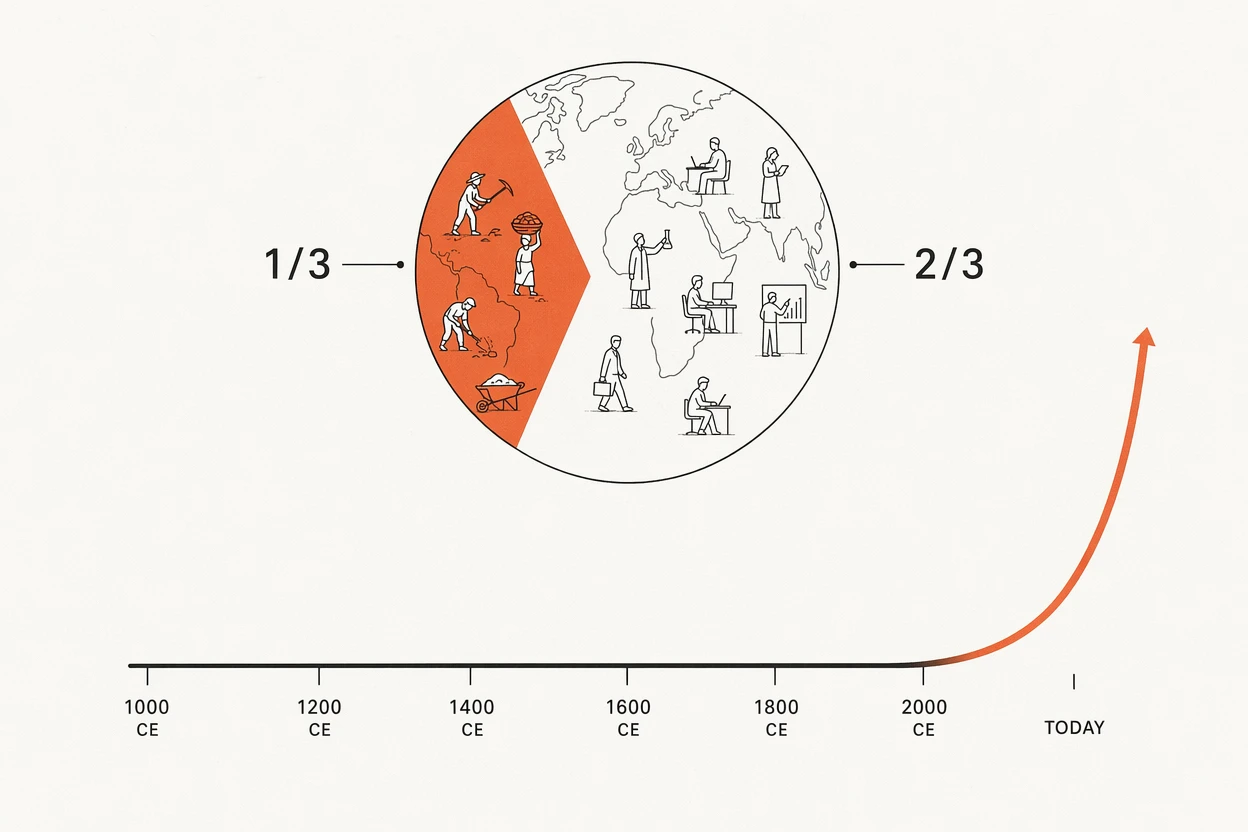
| Share of Labor Force | Approx. 65% (Nearly Two-Thirds) | Approx. 35% (Nearly One-Third) |
Interpreting this global picture: on this great human vessel, nearly two-thirds of the rowers (2.3 billion people) are rowing to maintain order within the hull, distribute food, mend the sails, and keep daily life going for everyone on board. They are the world's teachers, doctors, construction workers, waiters, and barbers.
The other one-third of the rowers (1.3 billion people) are the engine that actually drives the vessel forward. They are the world's factory workers, farmers, programmers, miners, and designers. By competing globally, they bring energy and resources back from the outside world for the entire ship.
The productivity and innovative capacity of these 1.3 billion people directly determine the vessel's speed, and they set the standard of living that the other 2.3 billion people can enjoy.
Chapter 3: Looking back at history, the millennium imprisoned by the non-tradable
This framework can explain the past as well as the present. One question has long puzzled historians and economists: why did humanity experience near-total economic stagnation for thousands of years between the Agricultural Revolution and the Industrial Revolution, falling into the "Malthusian trap"?
The answer is that the pre-modern economy was a closed system made up almost entirely of the non-tradable sector.
Take a medieval town as an example. The farmers, blacksmiths, bakers, and tailors in the town formed a self-contained loop. The wheat the farmers grew, apart from the portion paid to the feudal lord (wealth the lord used to buy a few luxury goods, not reinvested in the community), was almost entirely consumed locally. The economy was a zero-sum survival game based on barter. Did the town have a tradable sector? Yes, perhaps a spice merchant. But he served the lord, and the wealth he brought back went to building castles. It could not spill over to the local service sector to raise the income of the baker or the blacksmith. The engine's power was negligible.
So the poverty and stagnation of the medieval town came down to a failure to connect with the outside world. Without a powerful tradable engine to inject new wealth from outside, the whole society could only repeat itself in a low-level internal loop, unable to break through.
The Industrial Revolution was, above all, a revolution of the tradable sector. The steam engine, factories, and railways made it possible for the first time to produce and sell standardized goods (textiles, steel) on a massive scale to distant places. For the first time, humanity had an incredibly powerful engine. The immense wealth it created eventually spilled over and reshaped the whole society, freeing humanity from the millennium of stagnation in which the non-tradable had imprisoned it.
Summary: a key to understanding human progress
By inserting our tradable/non-tradable key into these three doors, we have obtained a coherent picture.
- At the metropolitan level, it reveals the different development DNA and urban characters of New York and Shanghai.
- At the global level, it maps out the contemporary human division of labor as a "1/3 engine vs. 2/3 hull."
- At the historical level, it explains why pre-modern societies stayed economically stuck for so long.
The framework tells us that the grand narrative of human economic progress is the work of constantly creating and strengthening the tradable sector and letting its fruits benefit the broader non-tradable sector.
Now that we understand how the past and present work, we will take this key in hand in our next article and step into the future. We will work out how this framework will evolve in the age of artificial intelligence and automation, and how it will shape a new world we have never imagined.