Part Five: Crossing "The Great Mismatch Era": The Difficult Road and Strategic Map to Future Prosperity
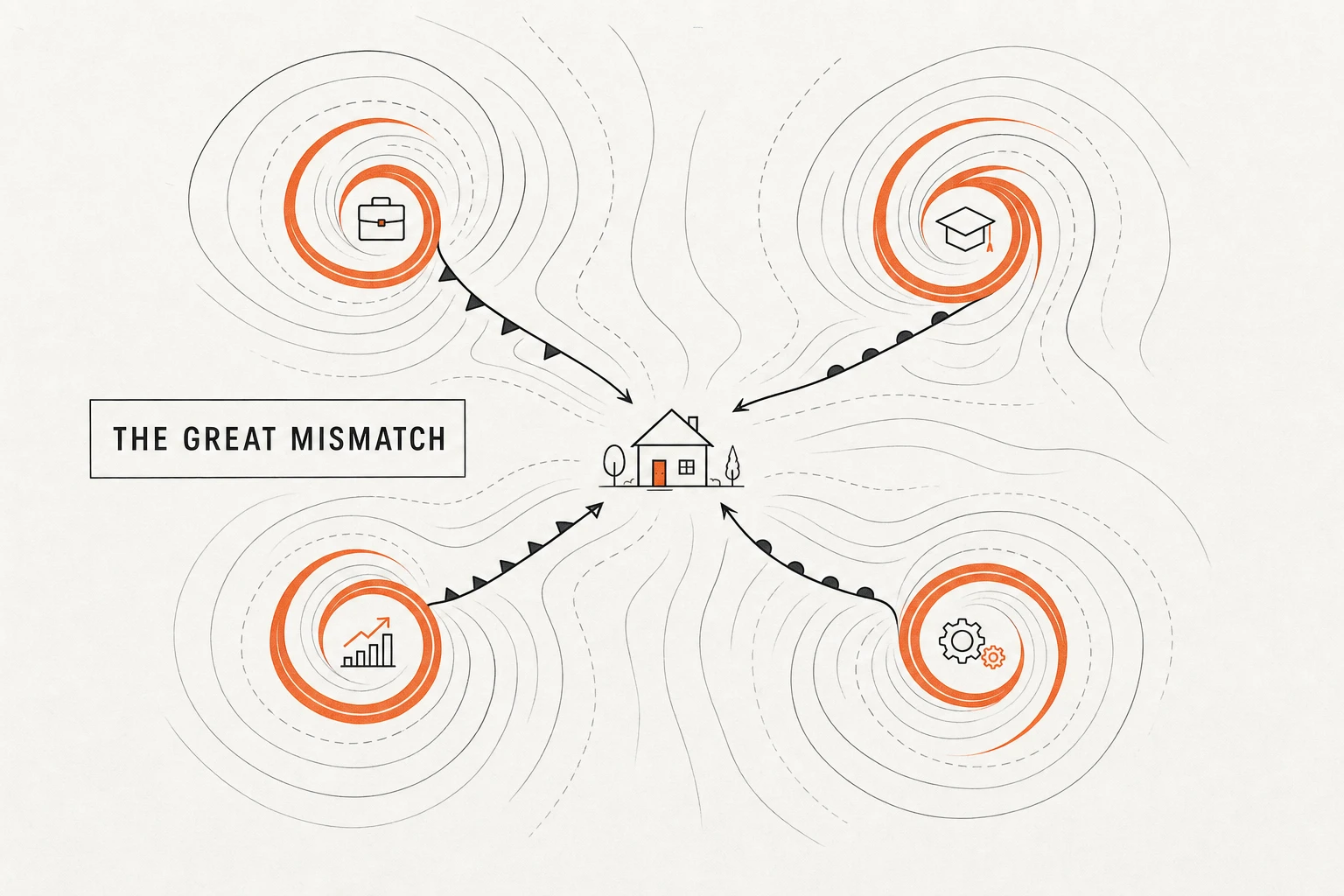
The storm of the Great Mismatch is four layers of mismatch resonating at once. You can't cross it until you see exactly how it's built.
(This is the fifth and final article in the series, "From Rural Towns to the Global Economy: A Thought Experiment on an Economic Model." Thank you for following along.)
We have come a long way through this thought experiment together. We started by dissecting the economic pulse of a small American town. We found the theoretical key of "tradable/non-tradable," used it to map the global division of labor, and finally projected a logically consistent "Binary Future."
Now it is time to write the final chapter. This article takes on the most urgent question of our time. From the contradictory "present" to that bright but distant "future," how exactly do we cross the deep valley of storms and fog that lies between?
Introduction: standing on the edge of a historical cliff
At the start of the series, we looked at the quiet of a small American town. In this final piece, we have to face the clamor and storms of our own era head-on.
As of September 7, 2025, we are standing on the edge of a historical cliff. Behind us lies the old economic paradigm of the Industrial Age, a paradigm centered on human labor that lasted three hundred years. It brought immense material progress, but it is now rusty and unsustainable. Before us is the blurry outline of a future world of immense productivity, driven by artificial intelligence, automation, and global interconnectedness. It promises a utopia that ends scarcity, and at the same time it evokes dystopian fears of mass unemployment.
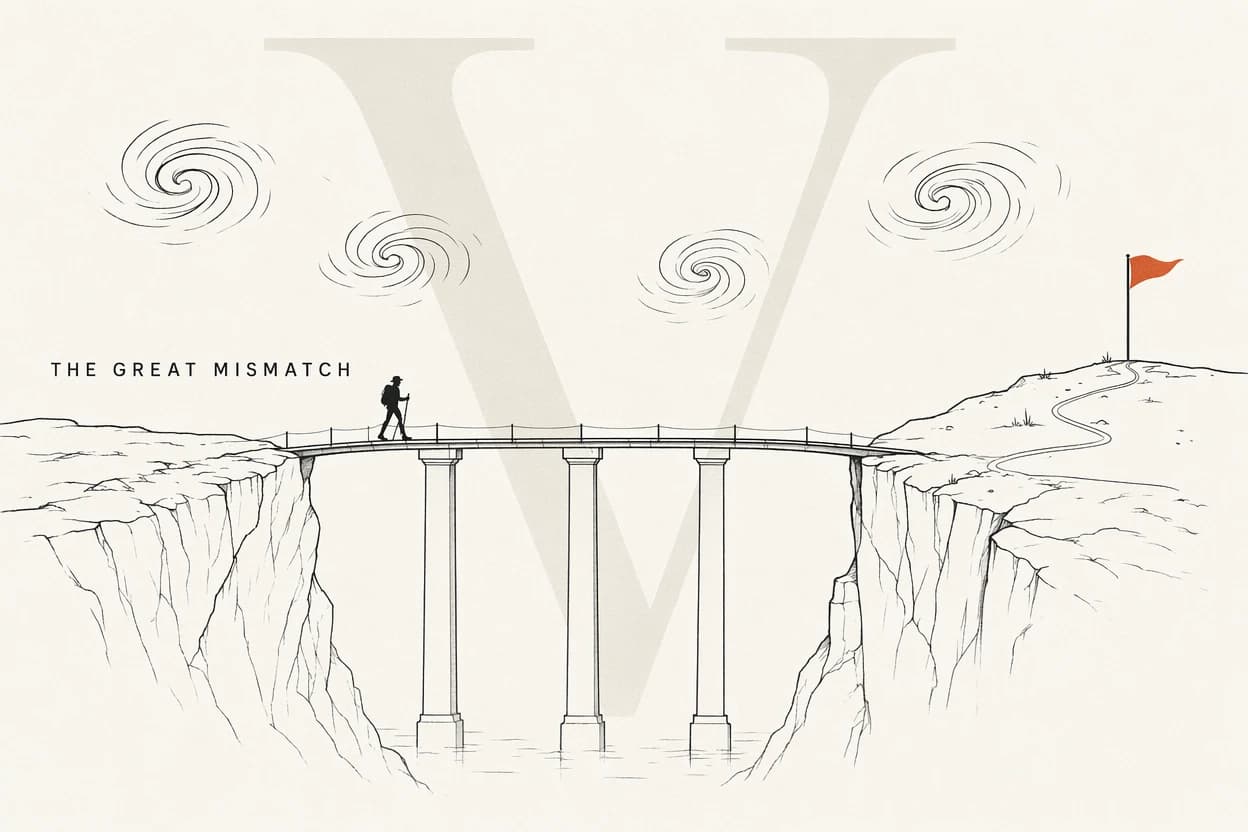
What connects the two is not a smooth, open road. It is a chasm of unfathomable depth, filled with unknown risks. This transitional phase is what we have to traverse: "The Great Mismatch Era."
In this era, our technological "hardware" is upgrading at an unprecedented speed, while our social "software" lags behind. That software includes our education systems, value systems, governance structures, and distribution mechanisms, and most of it remains stuck in the past. This huge mismatch between hardware and software is the root of all the anxiety, conflict, and confusion of our time.
This article, the finale of the series, will no longer offer predictions. Instead it will try to draw a strategic map. It diagnoses the nature of this storm, proposes a three-pillared strategy to steer our society through dangerous waters, and points toward a future shore that is more equitable, more prosperous, and more human-centric.
Chapter 1: Diagnosing the storm, the four core crises of "The Great Mismatch Era"
To get through a storm safely, you first have to understand what it is made of. The crises of this era are not one economic problem. They are a chain reaction of "mismatches" running across four levels.
1. The economic mismatch: the hollowed-out middle and K-shaped divergence
The old middle class was the stabilizer of the Industrial Age. Their jobs (accounting, administration, middle management, skilled blue-collar work) were standardized and repeatable, which makes them exactly the kind of work AI and automation replace most easily.
Current reality and trends: wealth is concentrating at an unprecedented rate among the "efficiency sector" elite who command technology and capital, while once-stable middle-class jobs are being systematically eroded. The result is a "K-shaped" recovery in the economy. The fortunes of a few are soaring while the real incomes of the majority stagnate. The mediocre "middle ground" industries, like traditional department stores, are dying off on a massive scale.
2. The employment mismatch: a crisis of jobs and a crisis of meaning
The Industrial Age promised that if you worked hard, you could earn a decent life and dignity. That promise is now breaking.
Current reality and trends: mass "low-quality employment" is replacing traditional full-time work. Hundreds of millions of people are pouring into the gig economy, becoming insecure "digital-age serfs." Even for those who still have jobs, automation has made many roles more procedural and "dehumanized," which produces a deep "loss of meaning." Society is living through a skills gap at the same time, where employers "can't find the right people" and workers "can't find the right jobs."
3. The social mismatch: the collapse of consensus and the rise of tribalism
When the economy's stabilizer (the middle class) and the main source of identity (a stable job) both start to falter, social cohesion comes apart.
Current reality and trends: people no longer find belonging in a unified social narrative. They retreat into "new tribes" built around online networks, values, and cultural identities. This makes social polarization and antagonism worse. Faced with a complex and uncontrollable future, nostalgia and populism become powerful political forces, as people yearn for an imagined past that was simpler and more orderly.
4. The political mismatch: navigating 21st-century oceans with a 20th-century map
Our current political systems, legal frameworks, and international relations were mostly designed for the industrial nation-states of the 20th century. They are proving inadequate for the technological shifts and global challenges of the 21st.
Current reality and trends: governments everywhere face the same dilemmas. The tax base is eroding because of automation, multinational tech giants are hard to regulate, and outdated education systems badly need reform. The old left-right political spectrum fails to answer these entirely new questions, which leaves us with widespread political paralysis and a deficit of trust.
Chapter 2: Charting the course, a three-pillared strategy for the future
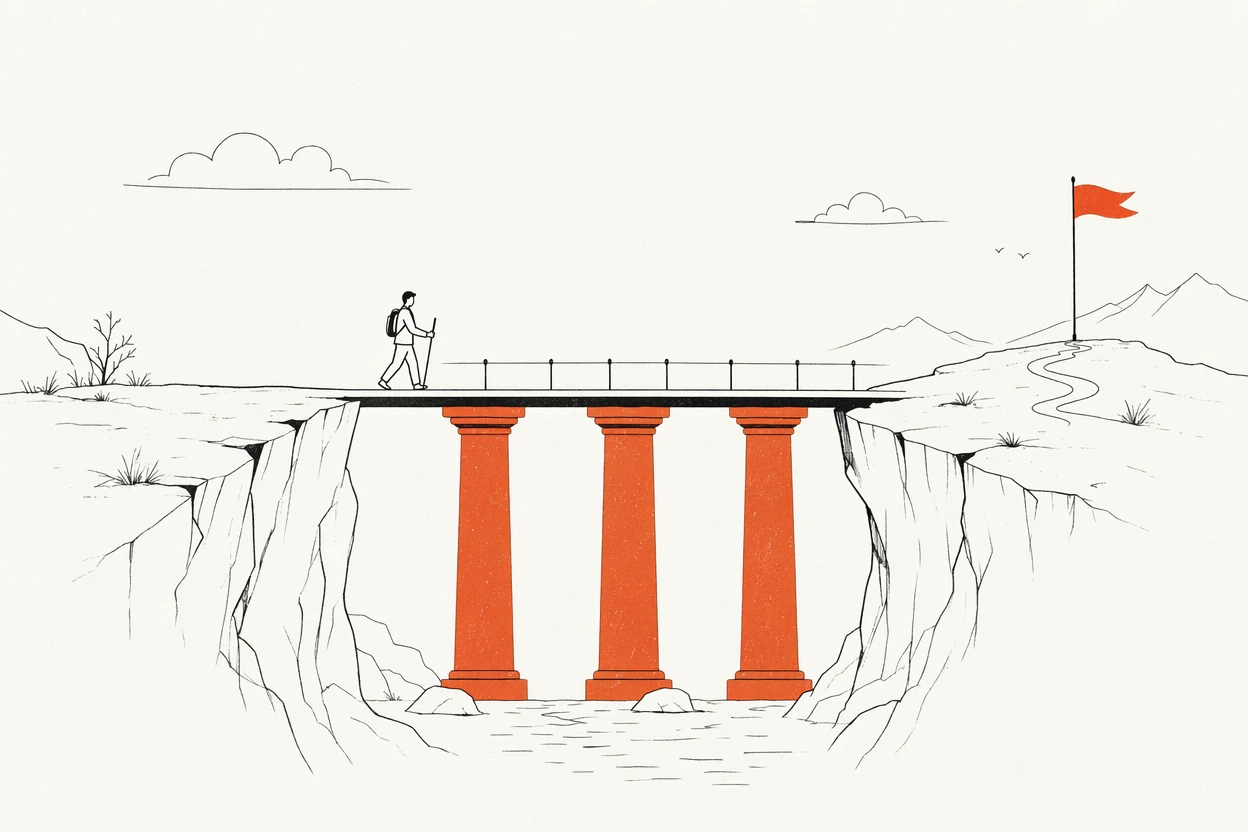
We diagnose the crisis in order to find a way out. To cross "The Great Mismatch Era" successfully, we need a large, multi-decade strategy that ties together technology, society, and politics. It rests on three pillars that have to advance in concert.
Pillar 1: Full acceleration for the "Efficiency Sector," building the engine of material abundance
This is the prerequisite for everything else. We cannot slow the pace of technological progress out of fear of unemployment. We have to reach a society of material superabundance faster and with more determination, not less.
- Launch "New Apollo Programs." Concentrate the world's top intellectual resources and capital, with the will of nations and even supranational bodies, to break through in three foundational technologies: Artificial General Intelligence (AGI), controllable nuclear fusion, and synthetic biology.
- Build a global automation infrastructure. This is the "new infrastructure" of our era: a global intelligent logistics network, automated factory clusters, computational power centers, and next-generation energy grids.
- Develop a global technology governance framework. Establish unified global standards for AI ethics, data privacy, and technological security, so that development stays safe, controllable, and useful to all of humanity.
Pillar 2: Reshaping the soul of the "Experience Sector," cultivating human-centric social soil
While we accelerate the "hardware," we also have to begin a deep upgrade of our social "software." The point is to make sure the 80% of the population can find their new place in the future.
- Undertake a complete educational revolution.
- The core: abandon rote memorization aimed at standardized tests and shift to competency-building aimed at "unleashing humanity."
- The goal: future education has to cultivate the four core competencies that AI cannot replace, which are critical thinking and complex problem-solving, creativity and imagination, empathy and collaborative communication, and lifelong learning and adaptability.
- The method: push hard for small-class, project-based, seminar-style, and apprenticeship models of teaching. Raise the humanities, arts, and physical education to a strategic status equal to science and technology.
- Promote a deep revaluation of values.
- Society has to learn to "walk on two legs." We have to celebrate and reward top community teachers, compassionate caregivers, master artisans, and artists who create moving work with the same admiration we give to tech billionaires. This cultural shift is what lets the "experience economy" flourish and draw the best talent.
Pillar 3: Building the bridge from "Old" to "New," managing the pains of transition
This is the most urgent and practical political task. During the transition, when the "Efficiency Sector" destroys old jobs faster than the "Experience Sector" creates new ones, we have to build a strong social safety net.
- Implement a phased "Universal Basic Income (UBI)." UBI is not a welfare program that encourages laziness. It is the "social venture capital" of the new era. It gives everyone an unconditional floor for survival, frees them from existential anxiety, and gives them the freedom and courage to experiment, learn, create, and find a place in the new economy.
- Establish a universal lifelong education and retraining system. Education has to be treated as a lifelong process. Governments should partner with businesses to give all workers displaced by technology free or subsidized, high-quality training for the new skills the "Experience Sector" requires.
- Design a new tax system that taxes "capital and algorithms." When the main source of profit is no longer human labor, the basis of taxation has to shift too. Future taxation should move away from personal income tax and toward taxes on capital gains, corporate profits, data usage, carbon emissions, and "robots/algorithms." Only then can the immense wealth created by automation be redistributed effectively to pay for UBI and support the whole societal transition.
Chapter 3: The individual in the storm, how should we navigate?
Faced with a historical transition this big, we as individuals are not just passive driftwood.
- Embrace lifelong learning and become an "adapter." The only certainty is uncertainty. Drop the illusion that one skill will carry you for life, and make continuous learning and skill updating a way of life.
- Invest in "humanity" and cultivate "soft skills." Whatever your profession, deliberately work on your empathy, communication, creativity, and aesthetic sense. In the future, these "soft skills" will be the "hardest" core competencies.
- Make a choice and reject mediocrity. Look at your career path and make a clear strategic choice. Are you pursuing "ultimate efficiency" or creating an "ultimate experience"? The most dangerous position is the "middle ground" that gets squeezed from both sides by AI and by experience masters.
- Build community and find "connection." In an atomized era, rebuilding deep emotional connections with family, friends, and community is a source of happiness, and it is also the strongest form of resilience against the risks of uncertainty.
Conclusion: the end of the thought experiment
Our long thought experiment began with a simple question about a small American town, and it has ended at a strategic reflection on where the global economy is heading.
The "Binary Future" we projected is not a destined prophecy. It is one of the best possible outcomes we can reach. And "The Great Mismatch Era" we are living through now is the decisive test on the path to that outcome.
For the first time in history, we have the technology to end material scarcity. That is both an unprecedented opportunity and an unprecedented responsibility. In the past, our history was a story of the "struggle with scarcity." In the future, it will be the story of "living with abundance."
That is as far as this thought experiment can go: one "tradable/non-tradable" key, a few order-of-magnitude estimates, and a list of hard problems for the transition. Reality will revise all of them. But the next time you read a headline about automation, a tariff fight, or a shrinking small town, you can take the key and pick the story apart yourself. That is what it was built for.