Part Two: One Key to Unlock Every Lock. Understanding Global Wealth Disparity Through the "Tradable/Non-tradable" Framework
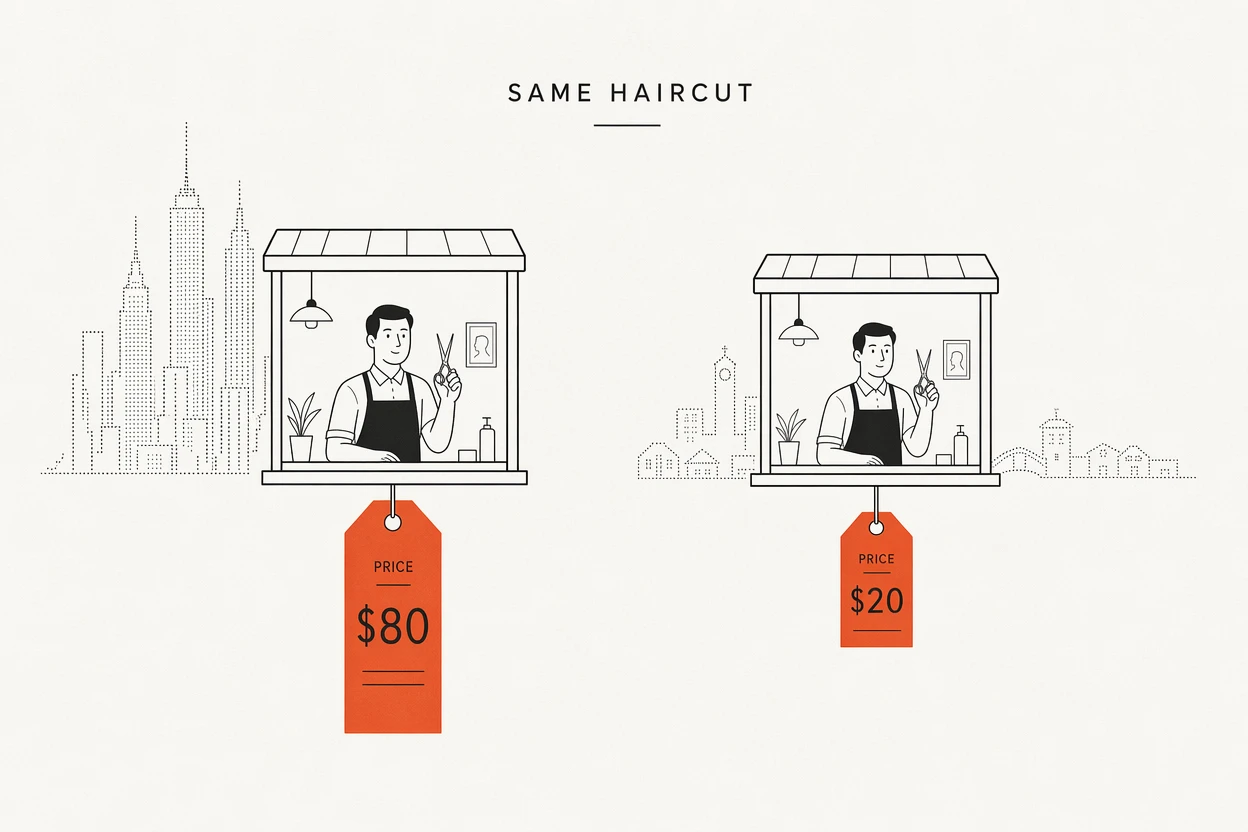
Why does the same haircut carry a wildly different price tag from one country to the next? Set the old three-sector model aside and look through a new lens: tradable versus non-tradable.

(This is the second article in the series, "From Rural Towns to the Global Economy: A Thought Experiment on an Economic Model." Please stay tuned for subsequent articles.)
In the previous article, we looked closely at America's local economies. From the quiet "Maple Creek" in Pennsylvania to the "hell's kitchen" of Manhattan, we saw a business ecosystem that was resilient and also brutally harsh. We found that everything from the thin profits of a boutique coffee shop to the survival miracle of a $1 pizza place came down to the local cost structure, especially rent and labor.
But once we widen the view and compare a small town in America with a small town in China, a harder puzzle shows up. Cost structure alone can't explain it, and working through it hands us a key that opens up the logic of the global economy.
Introduction: the puzzle of the two barbers
Let's imagine two scenarios.
Scenario one. On the Main Street of "Maple Creek," Pennsylvania, there is a small shop called "Bob's Barbershop." The owner, Bob, is a kind middle-aged man who has been in the business for over 20 years. A men's haircut costs $25 and takes about 30 minutes. His clients are the town's teachers, factory workers, and farmers. His income lets him afford a single-family home with a yard, two pickup trucks, and an annual family vacation.
Scenario two. On the old street of "Bluestone Town" in central China, there is also a "Master Wang's Barbershop." Master Wang is also a skilled middle-aged man. For the same haircut, using the same brand of clippers and scissors, he charges ¥20 RMB and also takes 30 minutes. His clients are the town's civil servants, factory workers, and small shop owners. His income lets him send his children to school and keep a decent but modest life in town.
Now, here is the puzzle.
Let's assume the skill, efficiency, tools, and service time of the two barbers are nearly identical. They both provide the basic service of "haircutting." Yet at the market exchange rate (1 USD ≈ 7.2 RMB), Bob's hourly wage is $50, while Master Wang's is ¥40 RMB (about $5.50 USD). Their nominal incomes differ by a factor of nine.
Why? Why does the exact same work carry such different economic value in different places? Some economic principle deeper than "operating costs" has to be at work, and that principle is the master key we'll introduce today for reading global wealth disparity.
Chapter 1: the engine and the hull, a new perspective on the economy
To solve the puzzle of the two barbers, we first need to set aside the traditional economic classifications: primary sector (agriculture), secondary sector (industry), and tertiary sector (services). That classification helps us understand the composition of an economy, but it can't explain the "unequal pay for equal work" problem in front of us.
We need a sharper analytical framework, one that splits any economy (a town, a country, or the whole world) into two core sectors.
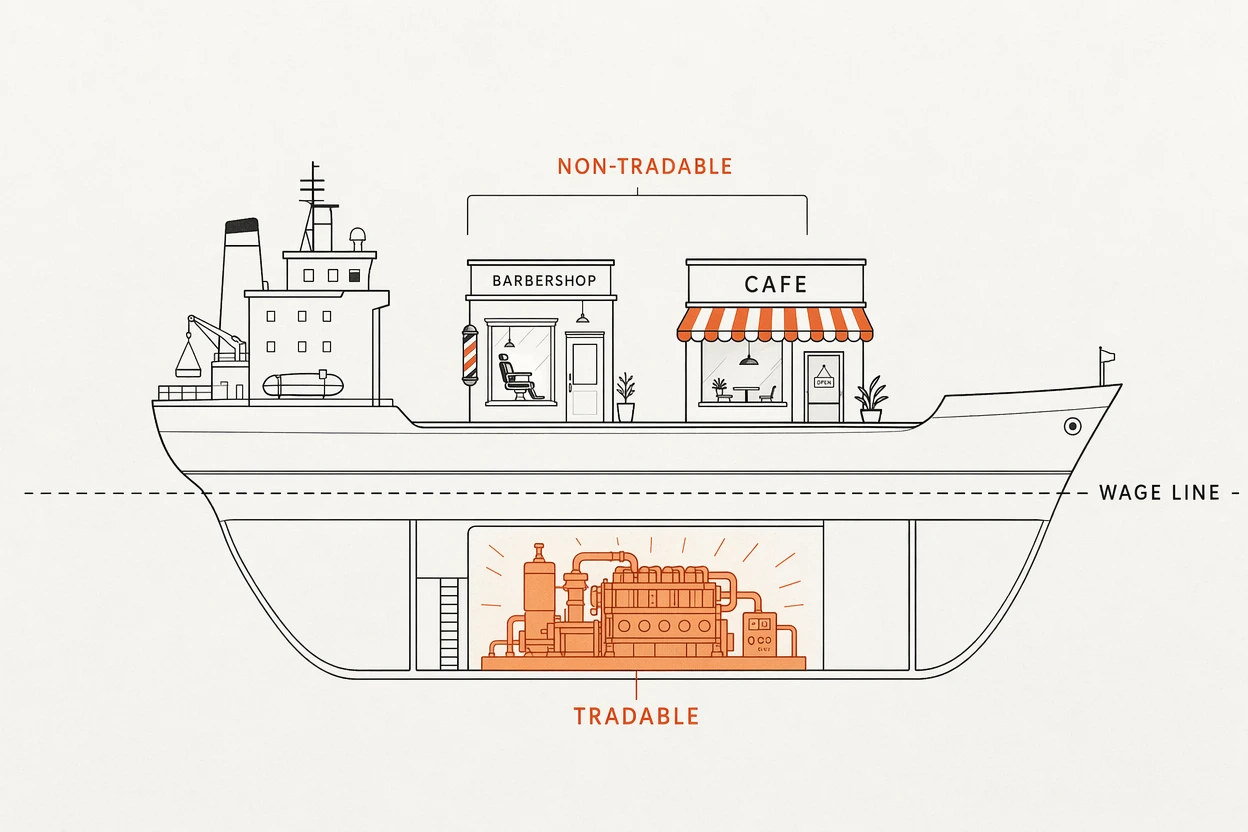
1. The economic engine: the tradable sector
The tradable sector produces goods or services that can be sold to a broad market beyond their place of production, with prices set by national or even global competition.
For physical goods, think of food produced in Maple Creek's factory, clothes made in Bluestone Town's factory, soybeans grown by Iowa farmers, copper mined by Chilean miners, and iPhones assembled in China for Apple. For intangible services, think of code written by programmers in Bangalore, financial services provided on Wall Street in New York, and movies produced in Hollywood.
This sector is the "engine" of an economy. Its job is to compete externally and "earn money" from the outside world. The productivity, technological level, and competitiveness of this sector directly determine how much new wealth an economy can create.
2. The economic hull: the non-tradable sector
The non-tradable sector provides services (and sometimes a few goods) that must be produced and consumed locally. They cannot be "exported" elsewhere, and their prices come down to purely local supply and demand.
Take the haircutting services provided by Bob and Master Wang. You cannot get a haircut in Bluestone Town and have it shipped to Maple Creek. The same goes for a dinner at a restaurant, a plumber's house call, local elementary school education, healthcare at a community clinic, city bus transport, and housing construction. This sector covers nearly all the local services we need day to day.
This sector is the "hull," or ecosystem, of an economy. Its job is not to create new wealth but to distribute and circulate the wealth that the "engine" earned from the outside, and to keep society running day to day.
With this key in hand, we can revisit the puzzle of the two barbers.
Chapter 2: the anchoring effect, how the engine sets the hull's waterline
The income gap between the two barbers has nothing to do with their hairdressing skills and everything to do with the horsepower of their respective economies' engines. A powerful engine systematically raises the "waterline" of the entire hull, meaning the overall local wage and price level. Call this the "wage anchoring effect."
Let's run a thought experiment comparing a programmer and a plumber in our two towns.
Scenario A: Maple Creek, Pennsylvania.
Start with engine horsepower. The town has a group of high-income professionals in the tradable sector. A programmer working remotely for a Silicon Valley company earns $150,000/year (approx. $75/hour); an engineer at the local high-tech factory earns $90,000/year (approx. $45/hour). These high-paying jobs set a very high opportunity cost and psychological price point for the Maple Creek labor market, which becomes the wage "anchor."
Now a plumber in town has to price their services. On the demand side, their clients (programmers, engineers) can easily afford a high fee. When a pipe bursts in the programmer's house, they will pay $150 for an hour of emergency repair, since that's only two hours of their own salary and it solves a big problem. On the supply side, the plumber knows that if their hourly rate falls below $40, they might as well take a more stable and less demanding job at the local factory. To attract and keep enough people in a tough trade like plumbing, the pay has to be attractive enough.
So, pulled by the powerful engine, the plumber's hourly wage gets anchored high, say $70. By the same logic, the wages of Bob the barber, restaurant waiters, and elementary school teachers all get lifted.
Scenario B: Bluestone Town, China.
The main tradable-sector workers in town are employees at the local garment factory, earning ¥5,000 RMB/month (approx. ¥30 RMB/hour). This wage level is the "gravitational pull" of the Bluestone Town labor market, the local anchor.
When the local plumber prices their service, they face a completely different reality. On the demand side, their clients (factory workers, small shop owners) can pay very little. Charging ¥200 RMB for a one-hour house call equals a full day's wage for a worker, who would likely try to fix it themselves. On the supply side, there's no reference point for a ¥200/hour job in town. An hourly wage of ¥40 is already quite competitive next to the ¥30 earned at the factory.
In this economy with a weaker engine, the hourly wages of the plumber and Master Wang the barber get anchored around ¥40 RMB.
The thought experiment makes one thing clear. The wage level of a region's non-tradable sector (local services) isn't set by its own productivity. It's anchored by the productivity and wage levels of its tradable sector (export industries).
This is the "spillover effect": wealth created by the tradable sector spills over into the local market as high wages, systematically raising everyone's income and local prices.
Chapter 3: the other side of the coin, purchasing power parity (PPP)
At this point you might ask: if Bob in Maple Creek earns 9 times more than Master Wang, is his quality of life also 9 times better?
No. To see why, we need the other side of the coin, purchasing power parity (PPP).
PPP starts from a simple idea. To measure a currency's real purchasing power, ignore market exchange rates and instead ask, "How much money does it take to buy the same basket of goods and services locally?"
The most famous example is The Economist magazine's "Big Mac Index." A Big Mac costs $6.00 in the US and ¥24.00 in China. At the market exchange rate (1:7.2), the Chinese Big Mac is only worth $3.33. But from a PPP perspective, to get the same good ("one Big Mac") the cost is $6 vs. ¥24, so the "Big Mac PPP exchange rate" is 1 USD = 4 RMB.
Why does this difference exist? Because the cost of a Big Mac includes not only tradable goods like beef and flour but also non-tradable services like employee wages and restaurant rent. China's non-tradable services (wages, rent) are much cheaper than in the US, which is exactly why the final price is lower.
What does this mean for our two barbers? Bob has both high income and high costs. He earns a high wage of $50/hour, but he has to spend it on equally high-priced local services anchored by the same logic: $3,000 in monthly rent, a $15 lunch, and a $30 dry cleaning bill. Master Wang has both low income and low costs. His hourly wage is only ¥40 RMB, but he pays for a ¥10 bowl of noodles, ¥1,000 in monthly rent, and a ¥20 dry cleaning bill.
So once you account for local prices, especially the prices of non-tradable services, the gap in real quality of life between the two barbers is far smaller than their nominal income gap. PPP works like a shock absorber, partly flattening the huge gap created by market exchange rates.
Chapter 4: a unified theory to explain everything we see
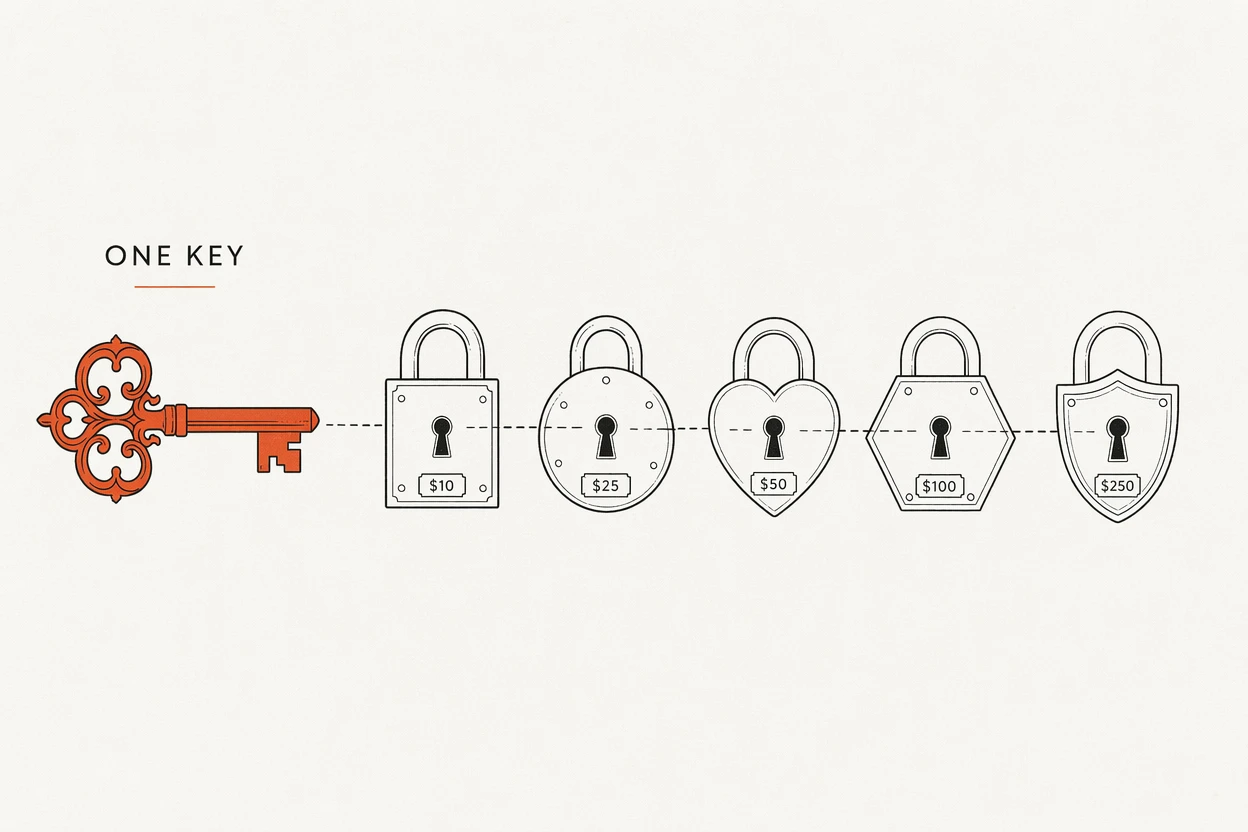
With the tradable/non-tradable key, we can go back and unlock all the puzzles from the first article.
Why can American small towns survive?
Because they have powerful enough "tradable" engines, whether that's highly productive agriculture, scenery that attracts tourists, niche manufacturing for a national market, or high-paying remote work. The external wealth these engines earn, through the anchoring effect, supports a prosperous and well-paid local service industry (the non-tradable sector).Why are the wages of a Manhattan barista so high?
Because Manhattan has one of the most powerful and productive "tradable" engines on the planet: global finance and legal services. An investment banker or lawyer working on Wall Street might earn $500 an hour or even $1,000. That enormous anchor pulls the prices and wages of every non-tradable service in Manhattan up to an unbelievable height. The barista's high salary comes from the spillover of Wall Street's wealth.Why can a $1 pizza place exist?
Because it uses a set of extreme business strategies (family labor, minimal rent, a loss-leader model) to cut itself off as far as possible from the high local "non-tradable" costs (formal high-wage labor, expensive storefront rent), and that's what makes the commercial miracle possible.
Conclusion: a worldview for seeing past the surface
The tradable versus non-tradable framework gives us a powerful new lens on the world economy. A few things follow from it.
To find the root cause of a region's wealth or poverty, don't just watch how bustling its internal commerce looks. Start with the engine, the tradable sector that competes externally and creates new wealth. What is it, and how powerful is it?
A region's prosperity ultimately shows up in the strength of its spillover effect. A strong engine pushes wealth and high wages through the whole economy, so barbers, teachers, and waiters all share in the dividends of development. An economy with a weak engine, however busy it looks inside, is just running "low-level internal circulation."
Any policy meant to grow a local economy should keep one question at the center: how do you make the local tradable sector more competitive? By attracting a high-tech factory, developing unique tourism resources, or cultivating digital talent that can serve a global market?
Once you hold this key, surface-level economic phenomena stop being confusing. In our next article, we'll use this framework to paint an economic picture that spans the globe and crosses history, and see how it explains the rise and fall of nations.