Part One: The Pulse of a Small Town, and the Survival Principles of America's Local Economies
How does a small American town that seems to produce nothing actually stay alive? A layer-by-layer dissection of what really keeps a local economy running.
(This is the first article in the series, "From Rural Towns to the Global Economy: A Thought Experiment on an Economic Model." Please stay tuned for subsequent articles.)
Introduction: the economic puzzle beneath the quiet surface
Drive through the vast American Midwest or the foothills of Appalachia, and you will pass through countless quiet, peaceful small towns. A white church steeple, a red-painted barn, a Main Street weathered by a century of history, a few rows of old Victorian houses, the air filled with the scent of grass and earth. These towns often have only three to five thousand residents and one or two traffic lights in the town center. Time itself seems to have been cast under a slow-motion spell.
A natural question arises in the minds of all outsiders: how on earth do people here make a living?
As far as the eye can see, there are no towering office buildings, no roaring heavy industrial zones, not even a decent-sized factory. The shops in town seem leisurely, with few customers. Compared to the "economic engines" like New York or Shanghai, which operate day and night with everyone bustling about, these small towns don't seem to "produce" anything. Their very existence feels like an economic enigma.
Yet beneath this tranquil surface, a resilient economic pulse is quietly beating. It doesn't rely on grand narratives. It is a complex, often overlooked network that intertwines the gifts of the land, the sediments of history, the connections of community, and the many threads linking it to the modern world.
This series looks closely at the fabric of America's local economies. We will start with a typical American small town and, like dissecting a sparrow, peel back the layers of its employment and income structure. We will go into the world's most expensive commercial environment, Manhattan, to watch how an independent coffee shop survives on a knife's edge. We will also work through a perplexing paradox: why can the most expensive cities produce the cheapest goods?
By the end, the goal is a complete picture of how America's local economies survive, and the ordinary business principles hidden behind the quiet.
Chapter 1: the anatomy of a small-town economy, much more than cows and corn
To understand a small town's economy, you first have to break a mental stereotype: "production" does not equal "manufacturing." A small town may not make iPhones, but it is constantly producing value, services, and goods. Its economic structure breaks down into three main sectors.
1. The visible pillars: gifts of the land and legacies of history
The most obvious economic pillars come from the town's geography and history.
Agriculture is the foundation of many small towns. Vast fields grow corn, soybeans, and wheat, or raise cattle and sheep. These are not just for self-sufficiency. They are tradable goods sold across the nation and even globally. A single family farm can support a chain of related industries, such as seed dealers, farm equipment repair shops, and grain transport companies. Agriculture is the "ballast stone" of the small-town economy, bringing in the most basic and stable external income.
Tourism is another major source of external income. If a town is lucky enough to sit near a national park or a scenic lake, or has a well-preserved historic district, tourism can become its economic engine. Hotels, restaurants, souvenir shops, and outdoor guides all serve outside visitors. Annual events like a "Strawberry Festival" or "Maple Syrup Festival" can bring a flood of cash to the town in just a few days.
2. The invisible foundation: the internal cycle that keeps society running
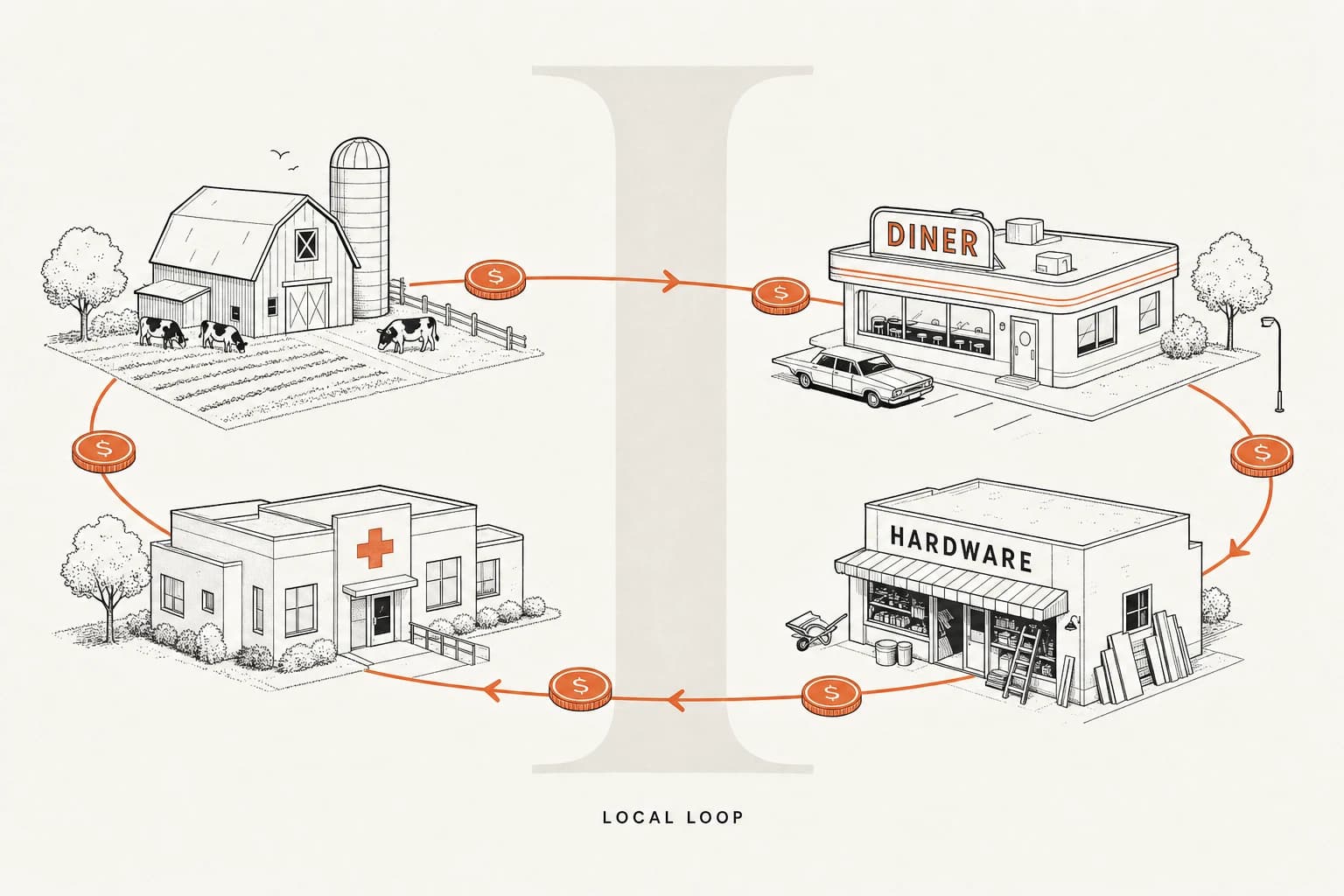
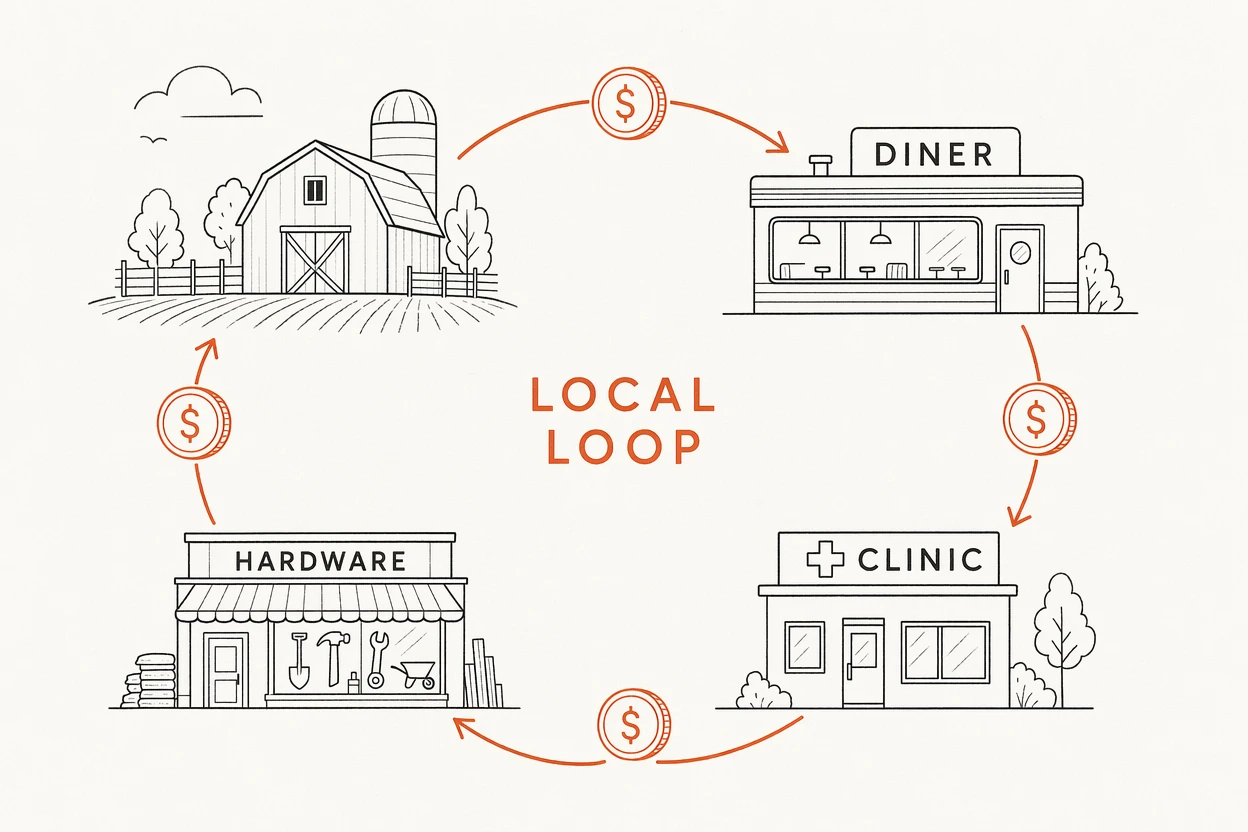
Larger and more basic than the pillar industries is the "non-tradable" sector that serves local residents. This sector employs the largest share of working people and forms the internal circulation of the town's economy.
Education and healthcare come first. No matter how small, a town will usually have a school district and a basic healthcare system. The school district is often the single largest employer in town, hiring everyone from teachers and administrators to bus drivers and custodians. Local clinics, dentists, and nursing homes provide a large number of stable jobs the town can't do without.
Then there is local business and services, the soul of Main Street. Grocery stores, hardware stores, pharmacies, banks, post offices, barbershops, auto repair shops. These businesses meet the daily needs of residents and keep the money earned from external sources circulating within the local community.
Skilled trades fill out the picture: plumbers, electricians, carpenters, and construction contractors. They build and maintain the town's homes and infrastructure, the "engineers" who keep the physical form of the community standing.
3. The new trends: connecting with the world
In a globalized world, no town is an island. Two new trends are reshaping how small-town economies work.
Niche manufacturing is one. Instead of large-scale, low-profit traditional manufacturing, many small towns have found a specialty of their own. It might be a factory making high-quality handmade furniture, a brewery turning out distinctive craft beer, or a company producing precision parts for a larger industrial chain. They are small in scale but high in added value, with products sold worldwide.
Remote work is the bigger change. As high-speed internet spreads, more and more people are choosing to live in small towns with lower living costs and better surroundings while working for large companies in distant cities like New York or Chicago. They bring big-city salaries back home to spend, a steady stream of fresh water for the local economy.
Chapter 2: a quantitative snapshot, welcome to "Maple Creek," Pennsylvania
To make all of this more concrete, here is a quantitative employment model for a typical American small town of 5,000 people, which we'll call "Maple Creek, PA."
Model assumptions: a total population of 5,000, and a labor force (age 16 and up) of roughly 2,500.
Estimated Employment Distribution in "Maple Creek" (Total Labor Force: 2,500):
| Industry Sector | Estimated # of People | Percentage | Core Insight |
|---|---|---|---|
| 1. Education, Health & Social Services | 750 | 30% | The town's foundation and largest employer. Includes ~300 working for the school district and ~450 in local clinics, nursing homes, daycare centers, etc. This is the most stable sector, least affected by economic cycles. |
| 2. Service Industry (Local Business) | 625 | 25% | Where the town's daily life happens. Includes 250 in retail (groceries, hardware), 225 in food & accommodation (restaurants, cafes), and 150 in other services (barbers, auto repair, banking). This is the core of the internal circulation. |
| 3. Manufacturing & Construction | 375 | 15% | The town's "heavy-duty" productivity. Assumes a food processing plant employing 200 people. The remaining 175 are construction workers, plumbers, electricians, and other skilled trades. |
| 4. Self-Employed & Remote Workers | 500 | 20% | The town's "new economy" engine. About half are local self-employed professionals (consultants, artists, small business owners), and the other half are "digital nomads" working remotely for outside companies. They are a vital source of external income. |
| 5. Public Administration (Government) | 125 | 5% | The community's managers. Includes employees of the town government, police department, fire department, post office, etc. |
| 6. Agriculture & Related Industries | 125 | 5% | The town's traditional roots. Includes operators and employees of surrounding family farms, as well as jobs in agricultural supply stores and produce purchasing. |
| Total | 2,500 | 100% |
This model shows how a quiet-looking American small town carries a surprisingly varied internal economy. It has a traditional base in agriculture and manufacturing, a large local service sector that handles internal circulation, and it is being reshaped by the new economics of remote work.
Chapter 3: an extreme case study, the "hell-level" survival challenge of a Manhattan independent coffee shop
The best way to understand how a system works is to watch it under extreme conditions. In the United States, there is no business environment more extreme than New York's Manhattan, where costs are world-class and competition is white-hot.
Take an independent specialty coffee shop in Midtown Manhattan called "Urban Grind Cafe," and look at its profit and loss statement for a typical month, August 2025, to feel what it's really like to run a "small business" at the center of the world.
"Urban Grind Cafe," Profit & Loss Statement, August 2025
| I. Revenue | Amount (USD) | |
|---|---|---|
| Monthly Customer Traffic | 8,100 (Avg. ~300/weekday, ~180/weekend) | |
| Average Spend Per Customer | $9.50 | |
| Total Monthly Revenue | $76,950 | |
| II. Expenses | ||
| A. Cost of Goods Sold (COGS) | Coffee beans, milk, pastries, etc. (25% of revenue) | $19,238 |
| B. Operating Expenses | ||
| Rent | 800 sq. ft., prime but not top-tier location | $12,000 |
| Labor & Payroll | 1 Manager (Owner) + 4 Full-time + 2 Part-time | $28,500 |
| Utilities | Commercial-grade electricity & water, very expensive | $1,800 |
| Supplies | Cups, lids, napkins, cleaning products, etc. | $2,500 |
| Bank & Credit Card Fees | Approx. 2.5% of card transactions | $2,000 |
| Other Expenses | Insurance, software, repairs, marketing, trash removal, etc. | $3,500 |
| Subtotal Operating Expenses | $50,300 | |
| Total Expenses (A + B) | $69,538 | |
| III. Profitability Analysis | ||
| Earnings Before Interest & Taxes (EBIT) | Total Revenue - Total Expenses | $7,412 |
| Less: Loan Repayments, Depreciation, Taxes | (Estimated) | -$4,674 |
| Net Profit | The final amount in the owner's pocket | $2,738 |
Reading this "battle for survival":
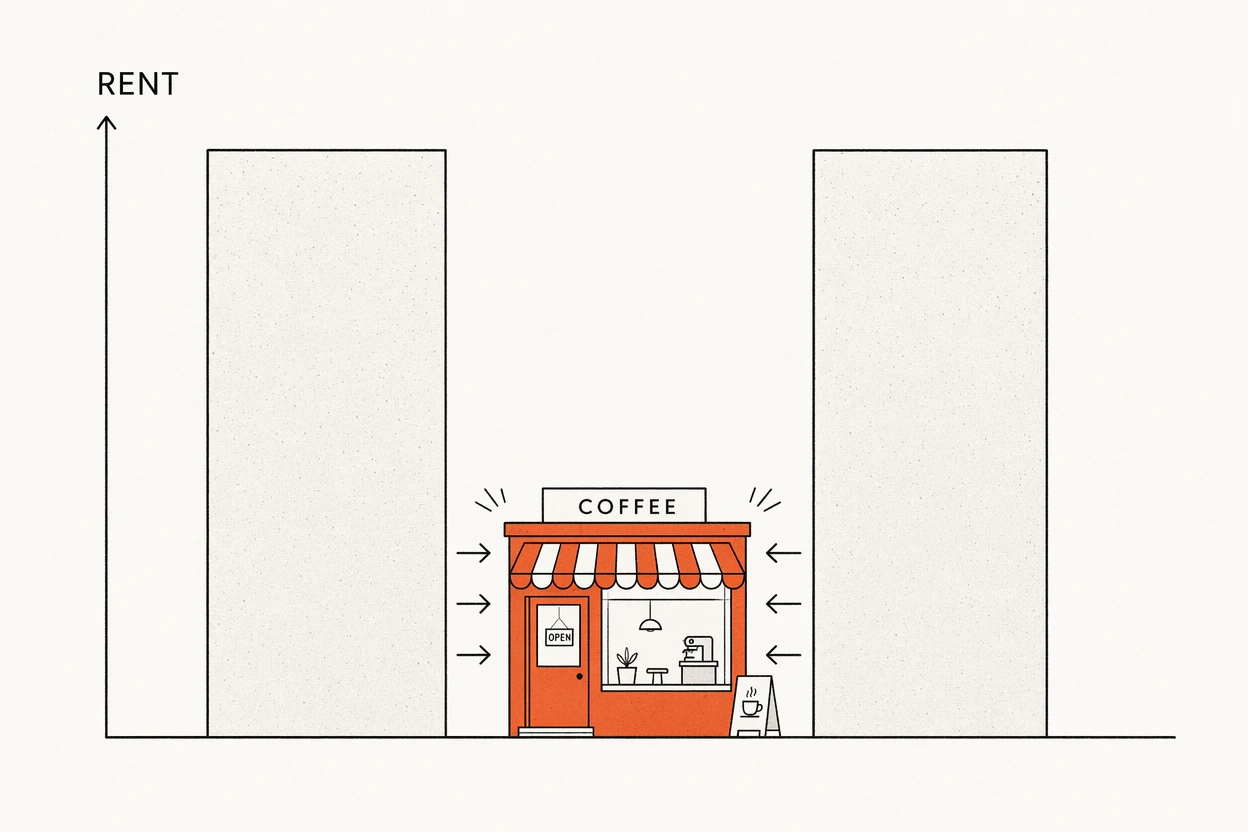
- The cost monsters. The most striking figures on this statement are rent ($12,000) and labor ($28,500). Together they eat 52.6% of total revenue. This is the first and most lethal challenge any entrepreneur who wants to open a shop in Manhattan has to face.
- Paper-thin profits. The cafe pulls in more than $76,000 in monthly revenue, but after all costs, loans, and taxes, the owner's net profit is a mere $2,738. The net profit margin is only 3.6%. This isn't a badly run cafe. It's doing quite well. This is simply the limit of what it can earn.
- The high-wire act of high volume. A daily flow of 300 customers is the lifeline. Any small swing, say a week of bad weather that drops traffic by 10%, is enough to push the shop into a loss. The owner walks a tightrope every single day.
- What "making a living" actually means. The $6,000 monthly salary the owner pays themself as manager is the main return from this venture. The net profit at the end of the month is more a fund for future development and a cushion against risk. Running a successful independent coffee shop in Manhattan is closer to creating a high-stress "job" for yourself than to an investment that leads to financial freedom.
Chapter 4: the Manhattan paradox, why does the richest city have the cheapest pizza?
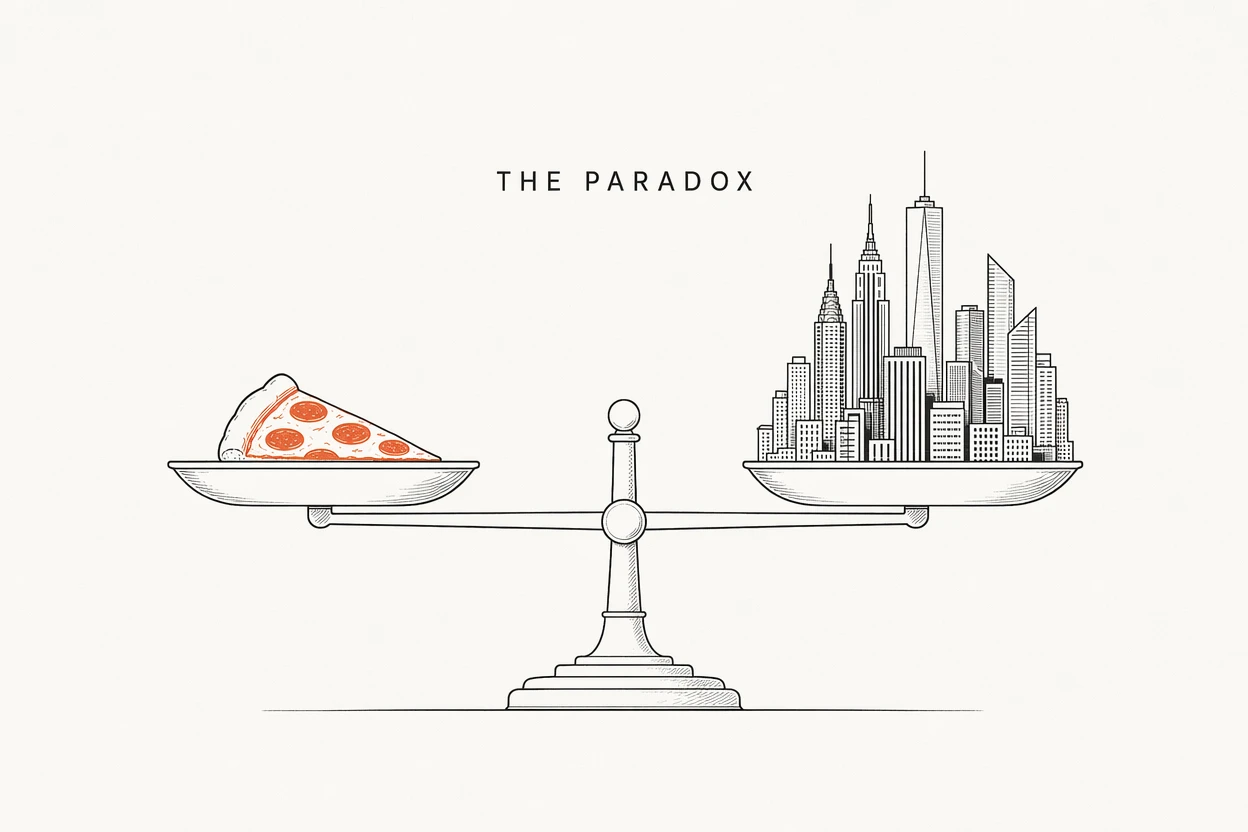
The case of "Urban Grind Cafe" shows how hard it is to run a "boutique" business in a high-cost environment. But that raises a sharper paradox: if so, how do the dollar-slice pizza shops, cheap nail salons, and corner delis on Manhattan's streets survive?
The answer is that they run on two completely different "survival models."
| Comparison Dimension | "Boutique Model" (e.g., Urban Grind Cafe) | "Survival Model" (e.g., $1 Pizza Shop) |
|---|---|---|
| Core Strategy | Create high added value; focus on brand, experience, and profit margins. | Extreme cost control; focus on efficiency and total profit volume. |
| Rent Strategy | Seek a balance of value in a "good" location. | Find the absolute lowest rent in a "secondary" location (side street, basement), and with minimal space. |
| Labor Model | Formal employment, paying market-rate wages, benefits compliant. | Primarily family labor. Living expenses replace formal salaries, avoiding significant payroll taxes and insurance. |
| Business Model | High average transaction value, medium customer volume, reliant on brand loyalty. | Extremely high customer volume, extremely low transaction value. Relies on a mix of a "loss leader" (the pizza) and high-margin add-ons (like sodas). |
| Cost Structure | High operating costs, every item clearly accounted for. | Extremely low raw material costs (benefiting from NYC's massive wholesale markets), with some transactions in cash. |
| Objective | Create a sustainable brand and realize a personal vision. | Support a family and generate a stable income source for the household. |
This split explains why Manhattan's economy is so unusual. It holds both very expensive "experiential" businesses serving a global elite and very cheap "survival" businesses serving students, blue-collar workers, and ordinary people who want the most value for their money. The second kind, through almost ruthless cost control and radical changes to the business model, carve out pockets of affordability in the most expensive city in the world.
Chapter 5: the big trade-off, the New York model vs. the rest of America
Is Manhattan's "hell mode" the norm in America? Of course not. Shift the view to a more representative mid-sized American city, say Knoxville, Tennessee, and see what life is like for an independent coffee shop owner there.
New York vs. Knoxville Coffee Shop Monthly P&L Comparison:
| Metric / Item | NYC "Urban Grind Cafe" | Knoxville "Knoxville Coffee Corner" |
|---|---|---|
| Total Monthly Revenue | $76,950 | $31,125 |
| Total Expenses | $69,538 | $26,148 |
| Of which: Rent | $12,000 | $2,333 |
| Of which: Labor | $28,500 | $11,100 |
| Net Profit (After Tax & Loans) | ~$2,738 | ~$3,200 |
| Net Profit Margin | 3.6% | 10.3% |
This comparison lays out "the big trade-off" in American small business:
- The New York gamble. Entrepreneurs trade profit margin for market size. They take on very high costs and razor-thin margins, betting on the high absolute profit that Manhattan's huge foot traffic can deliver. It is a high-risk, high-stress, high-reward gamble, if it pays off at all.
- The rest-of-America model. Entrepreneurs choose a steadier, more comfortable path. They give up a huge market ceiling in exchange for costs they can control and healthy profit margins. In Knoxville, the owner can pay themselves a decent salary and still earn a higher net profit than their New York counterpart. That profit gives the family a real financial safety net and lets them run the business and live with less pressure.
Conclusion: survival principles encoded in the DNA
From the quiet towns of Pennsylvania to the busy streets of Manhattan and the relaxed cities of the South, the survival principles of America's local economies keep coming back to a few core elements:
- There has to be an "engine." Every local economy needs one or more "tradable" sectors, whether agriculture, tourism, manufacturing, or remote work, to act as an engine that keeps pulling in wealth from the outside world.
- Internal circulation is the foundation. A healthy "non-tradable" sector serving the local community is the cornerstone for keeping wealth in town, creating jobs, and improving quality of life.
- Cost structure decides fate. Fixed costs, especially rent and labor, largely determine whether a business model can work at all and how well the operator lives.
- Diversity is where resilience comes from. Faced with fierce competition, entrepreneurs have grown a wide range of business models, from "boutique" to "survival," each finding a way to exist in its own ecological niche.
Back to the question we started with. Those quiet-looking small towns survive because their economies are not static. They are dynamic organisms that keep adapting. They work to hold a fragile but stubborn balance: between the land and the world, between tradition and modernity, between cost and opportunity. That balance is the truest pulse of America's local economies.