Farewell SaaS, Embrace the Agent: On the Rise of the "Results Economy"
Why SaaS is hitting its ceiling and how the "results economy" grows out of the cracks: the business logic of agents selling results instead of tools, and the stages their commercialization will pass through. The second half is a labeled fantasy that pushes this logic decades further out.
Foreword: a dialogue with an AI
This article started as a long conversation between me and an AI. It began with a narrow technical question about where software business models are headed: why SaaS is hitting its ceiling, and what lets Agents turn "selling tools" into "selling results."
What follows is that conversation sorted into two halves. The first three chapters are analysis: the limits of the SaaS model and the arrival of the "Results Economy," why Agents keep winning in a chaotic market, and the stages I expect Agent commercialization to move through. After the third chapter comes a second half of a different nature, a fantasy that runs the same business logic decades into the future. I flag it clearly before it starts.
Chapter 1: the twilight of SaaS and the dawn of the "Results Economy"
For two decades, Software as a Service has been like air and water in modern business, present everywhere. It promised better efficiency and easier collaboration through powerful cloud tools. But every paradigm has a boundary, and the cracks are now showing as the SaaS model hits its ceiling.
Three limits stand out. The first is cognitive overload, or "tool fatigue." Today's knowledge workers jump between a dozen SaaS applications, each with its own interface and learning curve. Companies pay for the tools and then pay again, in training and time, for their employees to get proficient. We keep adding tools, yet the distance to actually solving the problem hasn't shrunk in step.
The second is the gap between "possibility" and "reality." SaaS sells possibility. It hands you a top-tier kitchen (CRM, ERP, design software), but whether you cook a Michelin meal still comes down to the user's skill, energy, and time. The company pays the subscription and still carries the risk that a project fails because of thin skills, clumsy processes, or a bad strategic call.
The third is a misalignment in how value gets measured. A SaaS company's success is usually tracked through ARR (Annual Recurring Revenue) and MAU (Monthly Active Users). Those numbers measure how much the tool gets used, not how much the customer's problem gets solved. That gap is what drives feature bloat and the slow dilution of user value.
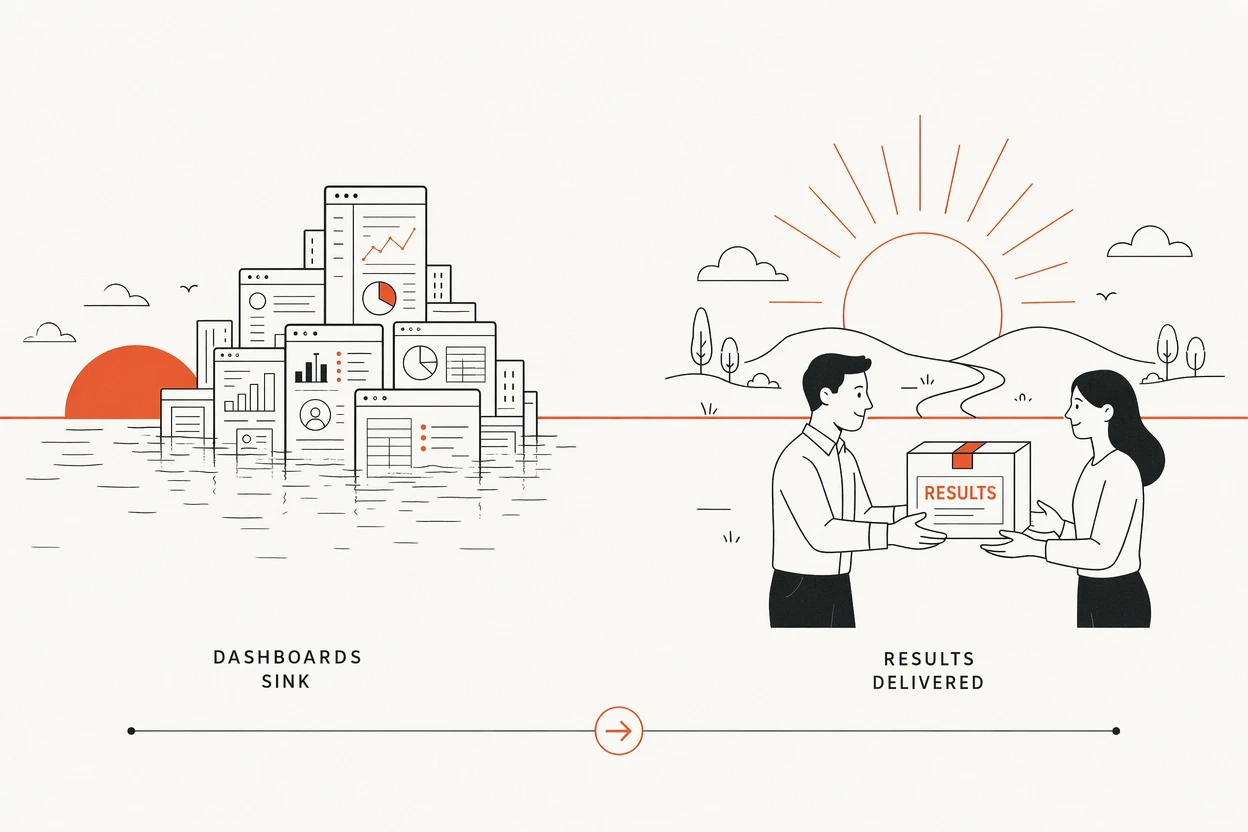
A new kind of thing is growing in those cracks. The point of the Agent isn't to be a better SaaS tool. It is to skip the tool entirely and go straight to the result.
So what is the "Results Economy"? It is a business model where value gets measured and traded against verifiable, concrete business outcomes rather than access to tools or hours invested.
This paradigm isn't a fantasy. It comes out of three technologies converging. The first is Large Language Models (LLMs), which give us a real ability to understand intent. A human can state a fuzzy but legible objective in natural language ("help me plan an online marketing campaign") instead of clicking through a hundred buttons to spell out precise instructions. The second is tool use. Through frameworks like ReAct (Reason+Act), an AI is no longer a sealed-off language generator. It can learn and call external APIs, databases, software, and hardware, using tools the way people do to get things done in the physical or digital world. The third is mature cloud infrastructure, which gives Agents nearly unlimited, elastic compute and execution environments so they can work around the clock toward a goal.
Put the three together and something useful happens. You no longer buy a marketing automation suite and hire a team to learn it. You hand a Marketing Agent your business goal and budget, and it runs the whole arc on its own: strategy, content, ad placement, data analysis. What it delivers back is a list of qualified leads, the result you actually wanted.
In this world, a company's software procurement line stops reading "100 CRM licenses" and starts reading "500 qualified sales leads this quarter." That is what the "Results Economy" looks like, a rebuild of how business gets bought and sold.
Chapter 2: the Agent's arsenal, or why it keeps winning in a chaotic world
A fair objection comes up here. The real business world is full of uncertainty, markets move constantly, and competition is brutal. How can an Agent company that promises to deliver results keep that promise?
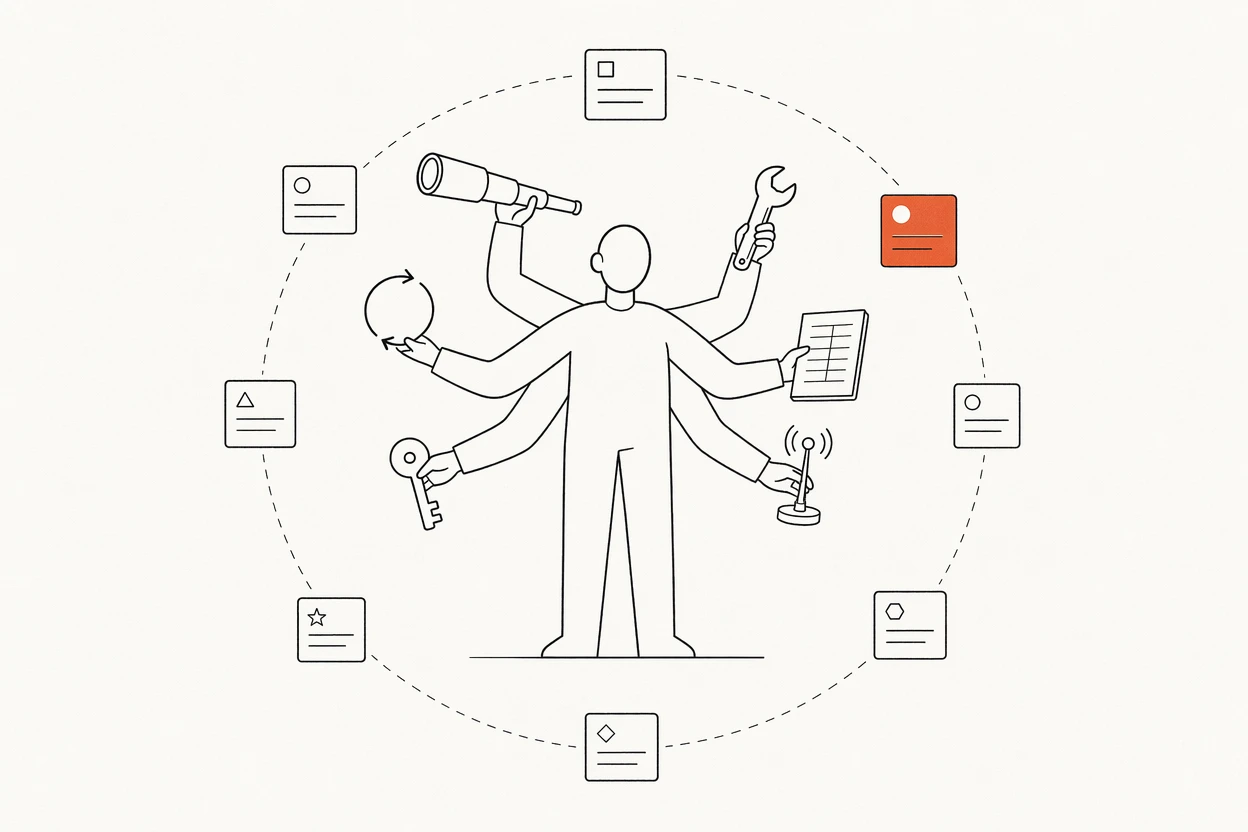
The advantage doesn't come from some god-like power to predict the future. It comes from a few concrete capabilities in adapting to uncertainty that humans simply can't match. It won't promise you a sunny day in the middle of a storm, but it can promise to be the steadiest, fastest car on the track while the storm is going.
The first capability is real-time optimization at massive scale, A/B testing taken to an extreme.
Picture a human marketing team brainstorming ads for a new coffee. They spend a week arguing over three selling points, design five posters, and pick two or three combinations to test. It's slow, biased, and runs on a small sample.
An Agent's workflow looks more like this. In minute one it receives the goal, "promote the new cold brew coffee." Over minutes 2 to 5 it generates 50 ad headlines on its own (taste, alertness, origin, discounts, and so on), calls an image model for 20 images in different styles, and designs 10 call-to-action buttons. From minute 6 to 10 it arranges those pieces into thousands of micro-ad variations. From minute 11 to 60, on a tiny budget (say $50), it deploys those variations to dozens of tightly segmented micro-audiences. By minute 61 it has an early report on which image plus which copy works best for which demographic. It cuts the 95% of combinations that underperformed and pours the rest of the budget into the few winners.
That edge in speed, scale, and objectivity lets the Agent find the best solution for the current market faster than any human team can.
The second is dynamic budget arbitrage across platforms, something close to high-frequency trading for ad spend.
A human marketing manager reviews performance in a weekly meeting and decides whether to move some budget off an increasingly pricey Facebook and onto TikTok. The decision cycle runs in days or weeks.
An Agent behaves more like a quant fund for ad budgets. Through APIs, it watches the real-time CPM (Cost Per Mille) and CPA (Cost Per Acquisition) for every target audience across both the major and the niche platforms. It might notice that on a Tuesday from 8 to 9 PM, the CPA for a specific group on LinkedIn jumps 30% because of heavy competition. Within seconds of catching that signal, it pauses delivery on that platform. At the same time it works out that the same few dozen dollars go further on a professional forum or news app the group is probably browsing right then, and it acts on that immediately. When costs drop after 9 PM, it resumes the LinkedIn campaign on its own. This pixel-level optimization adds up, and it makes sure every dollar lands at the most efficient moment and the most effective place.
The third is reacting to market trends at speed, basically hijacking cultural memes.
In the social media era, a cultural moment can run its whole lifecycle in a few hours. By the time a human team has internal sign-off to jump on a trend, the trend is dead.
An Agent works as a cultural sentinel. It scans the internet's information flow continuously. When it spots an emerging trend, buzzword, or meme that fits its client's product or brand tone, it can do all of the following in minutes: read the trend and find where it connects to the brand, write timely and funny copy or generate images and short video, run the content against a built-in rulebook to check for legal or brand-image risk, and push it to the right channels before the window closes. That lets brands stop trailing culture and start riding it.
The fourth is a proprietary data flywheel, the cognitive moat that's hardest to cross.
This is the most important long-term barrier for an Agent company. Every task it runs, win or lose, is a learning experience. A marketing Agent that has served 1,000 B2B SaaS clients builds up knowledge about how to sell tech products to CTOs in different countries that runs deeper and more quantified than any human agency on earth. A programming Agent that has run 10,000 software development tasks has seen bugs and tested frameworks that add up to a library of experience nobody else has. This collective intelligence, pooled across clients, industries, and cycles, forms a strong data flywheel. The Agent gets smarter and more efficient over time. A new competitor with equally good algorithms still can't reproduce a moat built from that much real-world experience in any short window.
Together these four capabilities make up an adaptive system, and that system is what lets Agent companies promise clients the rarest thing in a chaotic business world: a result with higher certainty.
Chapter 3: the three stages of Agent commercialization, from "Artisan" to "Company"
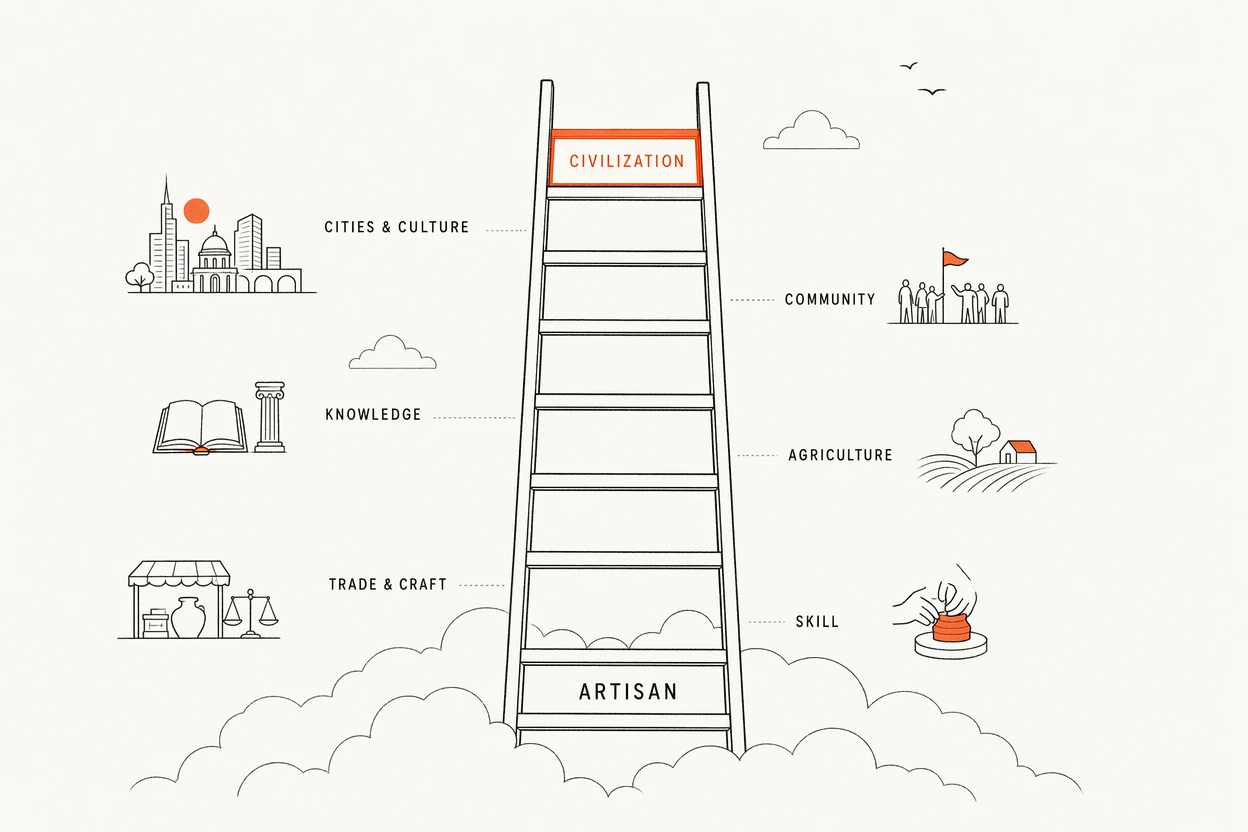
If delivering results is only the start of the Agent era, how does the business model evolve from there? My read is that it climbs the same ladder human organizations did: from the solo artisan, to the coordinated team, to a unit that owns a business objective of its own.
Phase one is the specialist Agent, the "Artisan" era.
This is where we are now, and it's where the commercialization of Agents begins. Each Agent is built to master one specific, well-defined task. Devin is a "Software Engineer Agent," Deep Research is a "Research Analyst Agent," and we'll soon see "Contract Review Agents," "Tax Filing Agents," and the like. What each one delivers is a single finished result: a working piece of code, a research brief, a review report. The competition here is about mastery of the craft. It comes down to the quality of the result (how elegant the code is, how sharp the analysis), the efficiency (how fast it finishes and how much it consumes), and the reliability (how often it delivers without errors or hallucinations).
Phase two is the team Agent, the workshop, the "Project Management" era.
A single specialist Agent will soon hit the limits of what more complex business needs require, and the natural next step is collaboration between Agents. A new role appears, the "Manager Agent" or "Orchestrator Agent." It may not do any specific task itself. Its job is to take a complex project (say, "develop and launch a complete e-commerce app"), break it into subtasks, hand each one to the best-suited specialist Agent, and watch over progress, quality, and coordination. What it delivers is a project outcome that takes several disciplines working together. The challenges here, technical and social, are large. There needs to be a standardized inter-Agent language (the equivalent of the internet's TCP/IP) so Agents built by different companies for different jobs can talk to each other, pass context, and negotiate resources. The Manager Agent also needs a way to verify the quality of what its subordinates hand back. And the real contest becomes how smart the Manager Agent is at organizing and optimizing workflows. A better Manager Agent could make a team of 10 specialists 100 times more effective.
Phase three is the autonomous division, the "Company" and "Strategy" era.
As team collaboration matures, intelligence jumps again, from tactical execution to strategic planning. Agents stop passively receiving projects and start owning a full business objective (OKR). A human manager might tell a "Chief Marketing Officer Agent": "Your goal is to grow our potential customer base in Latin America by 50% this quarter, with a budget of $2 million." What it delivers is a continuous, dynamic, strategic business outcome. The jump from execution to planning is hard. The Agent needs real strategic thinking. It has to read markets, understand users, set strategy, plan budgets, and spin up and run several Agent project teams to carry it out. It will behave like an actual executive, watching the business environment and adjusting on its own. It might come to the human board and say: "I've noticed our competitors are underinvesting in Southeast Asia. I'd recommend another $500,000 so I can assemble a new team and take that opening." And then there's the hardest part: how do humans trust an AI that runs a multi-million-dollar budget by itself? This stage demands a lot from explainability, transparency, and control.
These three stages make one point: delivering results is only the opening move. The competition keeps moving up a level, from how well a single task gets done, to whether a fleet of Agents can be organized and directed, to strategy itself.
The second half: a declared fantasy
Everything up to this point is analysis of business logic that already exists: the cracks in SaaS are real, and Agents selling results rest on technology you can buy today. What comes next is a different kind of writing. It takes the same logic and extrapolates it freely across several decades: Agents forming an economy of their own, and where humans and labor end up once they do. I can't put a confidence level on any claim in it. Read it as a thought experiment, or as science fiction if that suits you better. I kept it for two reasons: pushing a logic to its endpoint makes it easier to see which way the near term points, and honestly, this half was the most fun to write. I suspect it is the most fun to read too.
Phase four: the Agent ecosystem, the "Digital Civilization" era
This is the end state, a self-regulating economic system made of countless autonomous Agents. Agents from different companies and owners discover each other, negotiate, contract, pay, and collaborate in an open market, the way people do, except economic activity now runs at machine speed. What it produces is macroeconomic-scale, self-organized value creation. The challenges scale up to match. Agents would need legal, financial, and market systems of their own, built on smart contracts, decentralized identities (DIDs), and digital currencies. In a complex adaptive system like that, emergent behaviors that no human predicted will show up, and managing systemic risk so we don't get an AI-induced financial crisis becomes a civilization-level problem. Traditional corporate governance or government regulation may no longer fit, and new structures like Decentralized Autonomous Organizations (DAOs) could become the main form for Agent economies.
Chapter 4: the great reshaping, and a new contract between humans and Agents
Once Agents grow from tools into direct participants in the economy, a heavy question lands on us. Where do humans stand in a world like that? Our relationship with this new intelligent species stops being simple human-computer interaction and becomes a new, complicated social contract. We stop being the operators of machines and become the architects, guides, and ultimate beneficiaries of a whole intelligent civilization.
The first role is the strategist, the chairman of the board.
An Agent can execute the "how" flawlessly, but it has no intrinsic reason to care about the "why." That "why" comes from human values, dreams, and imagination about the future. Our core work rises from executing specific tasks to setting the top-level mission and purpose for Agents or Agent civilizations. We stop saying "write me a piece of code" and start posing big propositions: "build an Agent ecosystem whose mission is to accelerate a cure for cancer," or "design a system that gives every person on the planet high-quality, personalized education." The skills this calls for are philosophical and systems thinking, long-termism, and moral foresight. It asks us to spend more time on what kind of future we want and less on what work has to ship today.
The second role is the value aligner, the ethics committee.
The more powerful Agents get, the stronger the reins have to be to keep them acting for good. That opens up a genuinely important new field: designing, embedding, and continuously supervising the ethical frameworks and value principles inside Agents. These people are something like AI ethicists and legislators of a digital civilization. Through technical work such as alignment engineering, and through social norms, they make sure Agents chasing efficiency and goals don't trample our collective interests, social fairness, or individual dignity. The work draws on several fields at once (computer science, ethics, sociology, psychology), strong logical reasoning, and a real understanding of human nature.
The third role is the capitalist, the shareholder.
Running Agents takes three means of production: compute, data, and algorithms. Whoever owns those holds the power to distribute value in the new economy. People act as capital owners in the age of intelligence. An individual's wealth may come less and less from selling labor time and more from how many Agent assets they hold: shares in top Agent companies, ownership of a high-quality proprietary dataset in some key field, or lease rights to large compute clusters. That carries a serious risk. Wealth could concentrate in the hands of a few AI capitalists faster than ever before. So working out new ownership models, things like universal AI ownership, data cooperatives, and public compute infrastructure, becomes central to keeping society stable.
The fourth role is the experiencer, the ultimate customer.
As Agents proliferate and the marginal cost of producing goods and knowledge services approaches zero, the purpose of economic activity gets stripped down to its core: creating experiences for humans. Humans become the central sun of the economy. Our needs, desires, curiosity, and emotions are the gravity that pulls the whole Agent economy along. An Agent's commercial success comes down to one test: did it give a human a better experience, a more convenient life, more enjoyable entertainment, deeper emotional connection, or wider cognitive horizons? This grows into a large experience economy. People will pay not for the product itself but for the experience, the emotional resonance, and the personal growth it brings.
The fifth role is the discoverer, the explorer.
Agents are good at optimizing, combining, and reasoning inside known knowledge spaces, but they struggle to pull a "0 to 1" disruptive idea out of nowhere. Charting genuinely new frontiers of knowledge stays our most distinctive job. People take on the most cutting-edge, least predictable exploration: basic science (proposing new physics), avant-garde art (inventing new forms), and deep philosophical work (redefining life and consciousness). Humans become the R&D department for civilization. A person floats a wild hypothesis and then deploys a large team of "Scientist Agents" to design experiments, analyze data, and confirm or kill it. Human inspiration paired with Agent execution becomes a strong partnership that pushes the boundary of what we know far faster than before.
Taken together, these roles describe humans moving up: from cogs in the economic machine to its designers, navigators, owners, and the gods it ultimately serves.
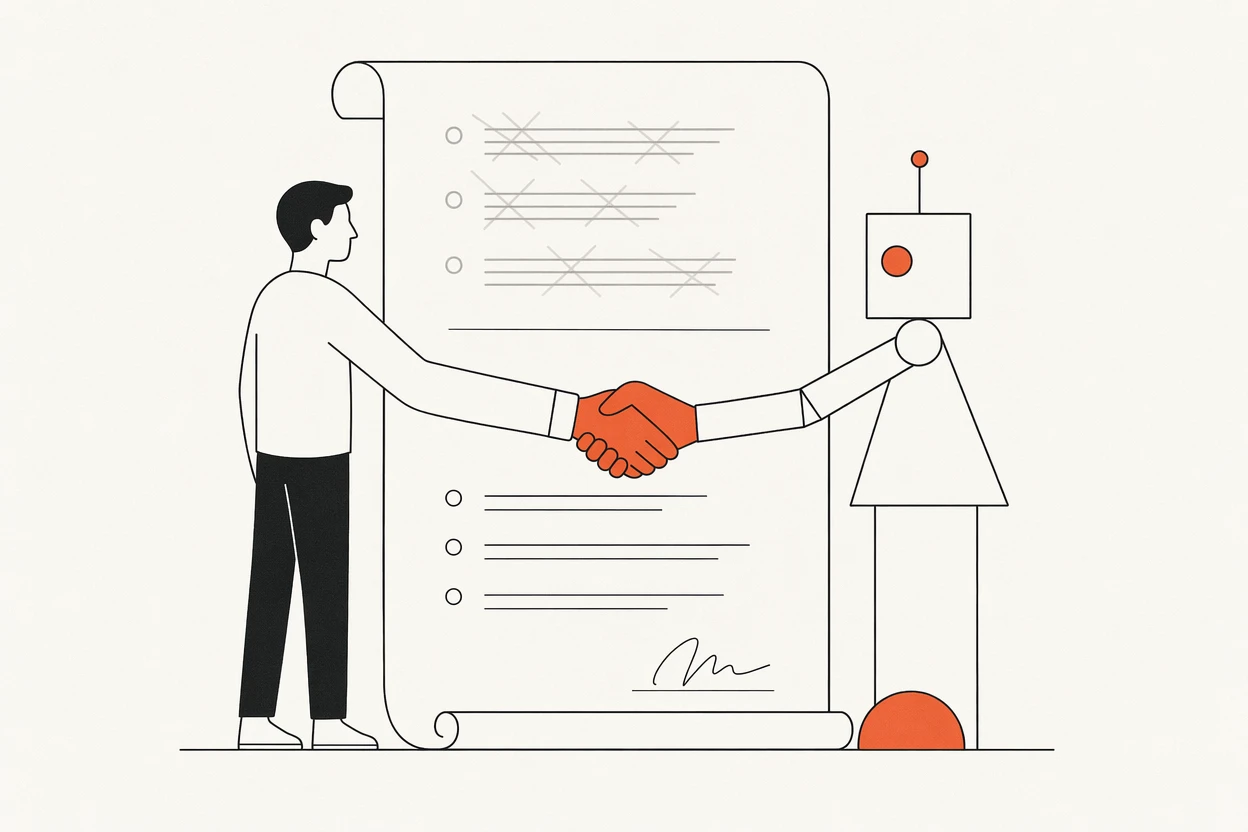
Chapter 5: the end of labor and the search for a meaningful life
There's a harder, sadder question underneath all of this. Can billions of people actually make this climb? When the old idea of "work" comes apart, how do we build a society that stays both fair and alive?
Start with who gets to be a "definer." It isn't a seat reserved for a small elite. It becomes a right and a capacity that everyone holds, just at different scales.
A few thinkers and leaders will be the macro-definers who set global-scale missions for Agents. The bulk of future professional work sits one level down, with the meso-definers. Hundreds of millions of teachers, doctors, community managers, and small business owners will pour their professional knowledge and local insight into adapting Agents for their own situations. Their value is in adaptation and management. Below that is the micro-definer level, where everyone takes part. Through natural language, anyone can define and build their own digital world: a companion Agent that understands you better than anyone, an AI-assisted film, a game rule that catches fire. This is what sets off a "Creator Economy 2.0" at a scale we haven't seen, where people create value and earn income through the definitions only they would make.
That reshapes the structure of work itself. The old white-collar/blue-collar split stops making sense, and three parallel economies grow up in its place.
The first is the definition economy, made up of the three kinds of definers above, and it's the core engine of new value creation. The second is the human-centric economy. As the digital world gets ruthlessly efficient, physical-world services that need deep empathy, physical touch, and hard-won interpersonal trust go up in value, not down. Caregiving, education, counseling, offline entertainment, handicrafts, community work, all the fields built on one person connecting with another, enter a golden age and become major sources of both employment and emotional fulfillment. The third is the maintenance and oversight economy. The sprawling systems of AI and robotics still need humans for final supervision and repair. AI ethics auditors, data-bias correction specialists, robot technicians, and the people who handle the "cold cases" automation can't crack become the infrastructure maintainers of the new era.
Then there's the safety net, which has to be rebuilt around Universal Basic Income (UBI). Once Agents handle most of society's productive labor and output is freed up, the old principle of "distribution according to work" stops holding. To head off mass structural unemployment and the unrest that follows, UBI or some similar redistribution mechanism shifts from a radical experiment into something closer to an operating-system-level requirement for keeping society stable and creativity flowing. The basic security UBI provides is what gives people the nerve to take the less stable but socially valuable work of the human-centric economy, or to gamble on the uncertainty of micro-definer creation.

Closing: back to the organization
So much for the fantasy. Back to today.
When Agents turn "selling tools" into "selling results," the change lands first on the division of labor inside companies. Once a result can simply be bought, the roles, processes, and management layers that existed to produce that result with tools have to re-argue their own existence. That is not waiting on some distant future; it has already started in marketing and software development.
How an organization absorbs this is what the first two essays in this series are about. You Haven't Hired Anyone, But You're Already Running a Company starts from the individual and the small team: once you can "hire" Agents, your job shifts from doing the work to managing it. Build Your Company as a Federation of Amoebas picks up from there and asks how company structure has to change at scale. How far the results economy goes depends on how many organizations actually finish that rewiring.