The Hidden Scaling Laws of Startup Engineering: What I Learned Building 50K Lines of Code in 2 Months
How doubling your codebase creates completely different engineering challenges, and why most teams aren't ready for the transitions.
A note before you start: this was written in May 2025, and its judgments and numbers only reflect the model capabilities of that time. Models have moved fast since, and some of these conclusions no longer hold — read it as a snapshot of that moment.
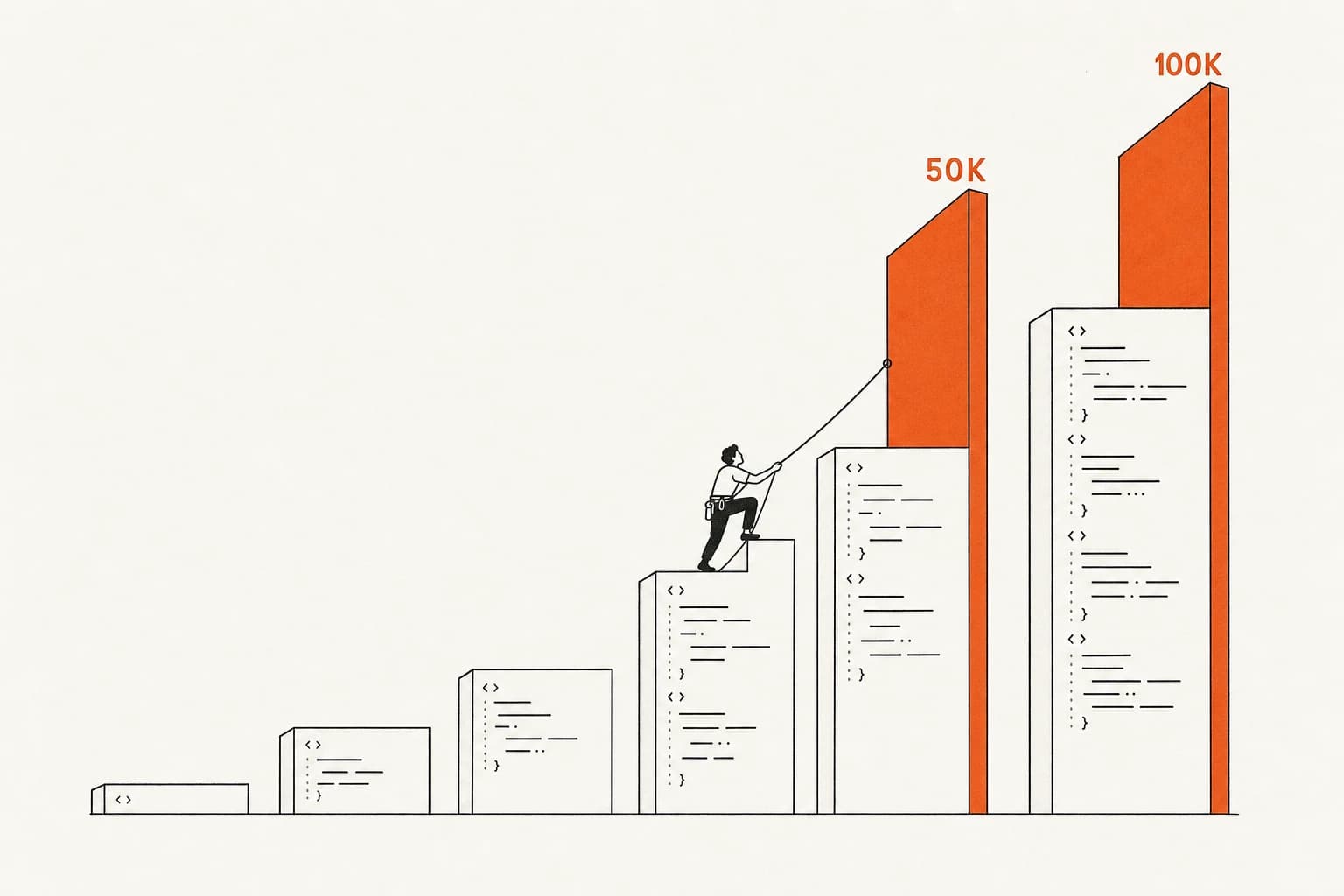
Doubling a codebase doesn't just add more code. It changes the kind of problem you're solving.
When I started my recent startup project, my co-founder and I began building a React Native app. We've just hit 50,000 lines of code, grown to around 1,000 daily active users, and somewhere along the way I noticed something: every time the codebase doubles, you're in a different stage of development.
It isn't simply a matter of more code. Each doubling changes the problems, the team dynamics, and the architectural decisions you're dealing with. Below is what I've learned about the scaling laws that quietly govern startup engineering.
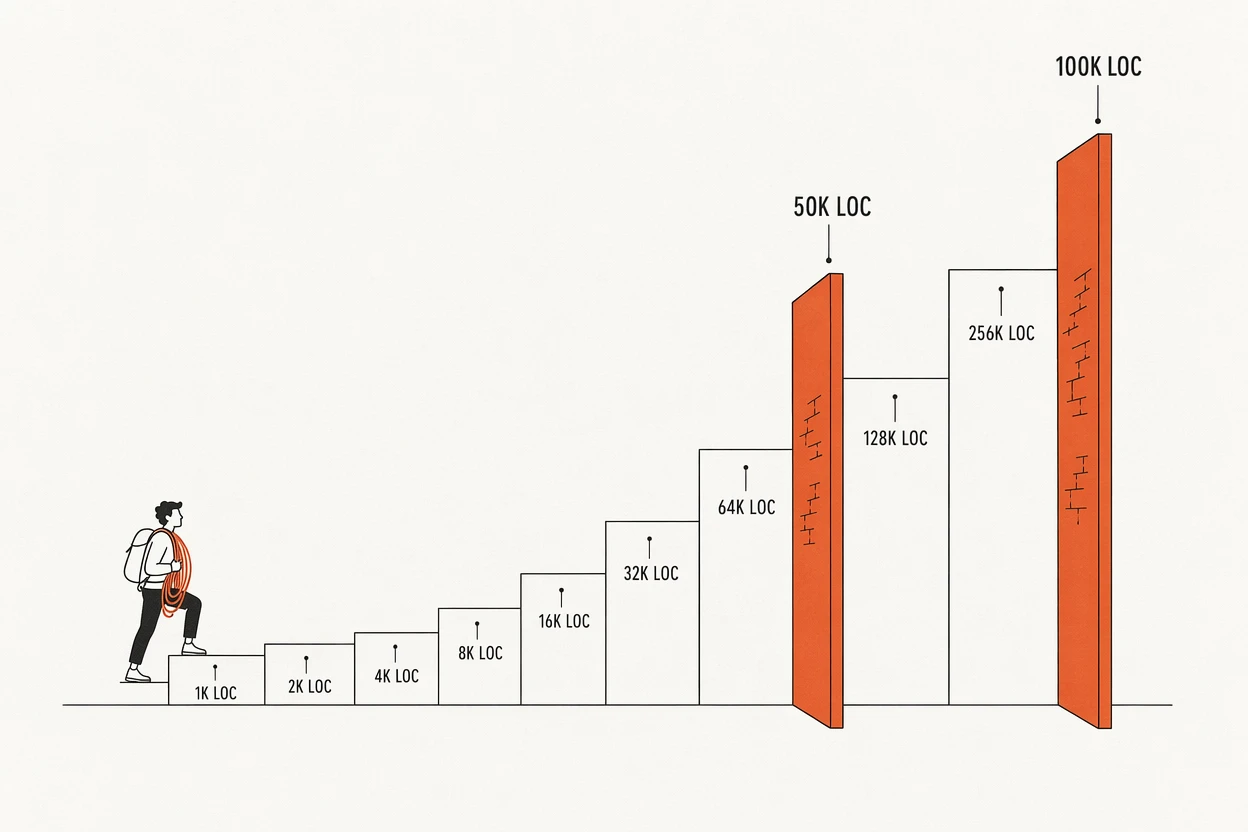
The doubling rule: each 2x jump is a phase transition
Through our own experience and some research, I've landed on a rough pattern:
- 25k → 50k LoC: Prototype to functional product
- 50k → 100k LoC: Product to sustainable system
- 100k → 200k LoC: System to platform
- 200k → 400k LoC: Platform to enterprise architecture
- 400k → 800k LoC: Enterprise to large-scale distributed systems
Complexity doesn't grow linearly. Twice the code means roughly 4x the potential interactions between components, and each doubling pushes past another cognitive boundary for what a person can hold in their head and maintain. Conway's Law, Dunbar's number, and Brooks' Law each describe a piece of why: the social and technical limits on how we build software.
Stage 1: the 50k LoC reality check
We're currently in what I'd call the "product to sustainable system" transition. Here's what it actually feels like:
- State management becoming a nightmare across components
- Technical debt from rapid prototyping catching up
- Performance issues (we spent days optimizing a FlatList that was blocking users)
- "Simple" changes now touching multiple files
- Constant context switching between frontend, backend, mobile, and infrastructure
At 50k LoC with two engineers, we're hitting cognitive load limits. We can still hold most of the system in our heads, but only just.
What's coming next: the 100k LoC wall
Based on research and conversations with other engineering teams, here's what seems to wait at the next doubling.
On the architecture side: the monorepo starts to feel unmaintainable, service boundaries blur, the database becomes a bottleneck, and disputes over code ownership begin.
On the coordination side: merge conflicts everywhere, features breaking other features, knowledge silos forming, and release coordination turning painful.
And one blunt rule of thumb from the teams I've talked to: most of them needed their third engineer around 75k LoC, well before they thought they did.
How team size actually scales
I initially assumed team size might need to scale 4x when code doubles, following the complexity growth. The real pattern looks more like 2-3x team growth per LoC doubling:
- 50k → 100k LoC: 2 → 4-6 engineers
- 100k → 200k LoC: 4-6 → 10-15 engineers
- 200k → 400k LoC: 10-15 → 25-40 engineers
It's not 4x because good engineers adapt, tooling improves, and people specialize. But coordination overhead is real, and communication complexity grows quadratically as you add people.
Which technology choices scale, and which don't
One of our bigger decisions was state management. We chose Zustand over Redux for our current stage:
- 5-10 minute setup versus 30-60 minutes for Redux
- Less boilerplate when iterating fast
- Easier refactoring during architecture changes
- Better performance in React Native
Redux gets attractive again past 100k LoC, though, once complex async flows dominate, multiple developers need established patterns, time-travel debugging becomes essential, and large state trees need better organization. The point isn't that one tool is better. It's to optimize for your current stage, not your imagined future.
Preparing for the next transition
The smartest teams prepare for these transitions before they hit the wall. What we're investing in now:
- A solid state-management foundation, since getting it right now saves months later
- A component design system, to establish patterns before the UI diverges
- An API abstraction layer for consistent data fetching and error handling
- Performance monitoring, added before we desperately need it
Call it the 20% rule: we spend about 20% of our time now preventing problems, rather than 60% later fighting fires.
Performance matters even at 1,000 users
Here's something I learned the hard way: performance blockers kill growth regardless of scale. We spent several days fixing a FlatList issue that was stopping users from reaching core features.
Even at 1,000 DAUs, people won't tolerate broken UX. This isn't premature optimization. It's removing the barriers that keep users from adopting the product at all.
Build for 10K users, not 100K
We're targeting 100K users in six months, but we're building for 10K first. The reasoning:
- Architecture decisions that work for 10K can evolve toward 100K
- Over-engineering for 100K adds complexity that slows us down right now
- We still need to prove product-market fit before optimizing for massive scale
- Different scales bring different problems, and call for different team sizes
The pragmatic guidelines we follow
Out of all this, we've written down some guidelines, both for ourselves and for our AI coding assistant:
- Fix performance blockers immediately, because users won't wait
- Choose simple solutions that can evolve
- Design for easy migration, and avoid tight coupling
- Add complexity only when the current approach breaks
- Prefer simple, maintainable patterns over "enterprise-ready" ones
- Favor patterns that can grow with the team
- Keep essential monitoring, not an enterprise observability platform
If you're early, here's what to watch
If you're building a startup, these are the early signs that you're approaching a transition:
- Simple changes taking longer than expected
- Developers spending more time debugging than building
- Performance issues affecting the user experience
- The team starting to say "we should probably refactor this"
And a few concrete triggers for acting on it:
- Add complexity only when the current approach causes frequent bugs
- Upgrade the architecture when team coordination becomes the bottleneck
- Hire when maintenance work exceeds 40% of development time
What we're doing next
We're preparing for the jump to 100k LoC now. Concretely, that means investing in testing infrastructure, establishing clear component boundaries, planning our third hire for around 75k LoC, and building out deployment automation.
The thing I keep coming back to is that successful scaling isn't about predicting the future. It's about building systems that can evolve. Every doubling brings new problems, but it also brings new capabilities, and the teams that do well are the ones who spot the transitions early and prepare for them.
What scaling challenges are you running into? I'd genuinely like to hear where your own system started feeling heavy.