The More Mental Models You Master, the More Useful AI Gets
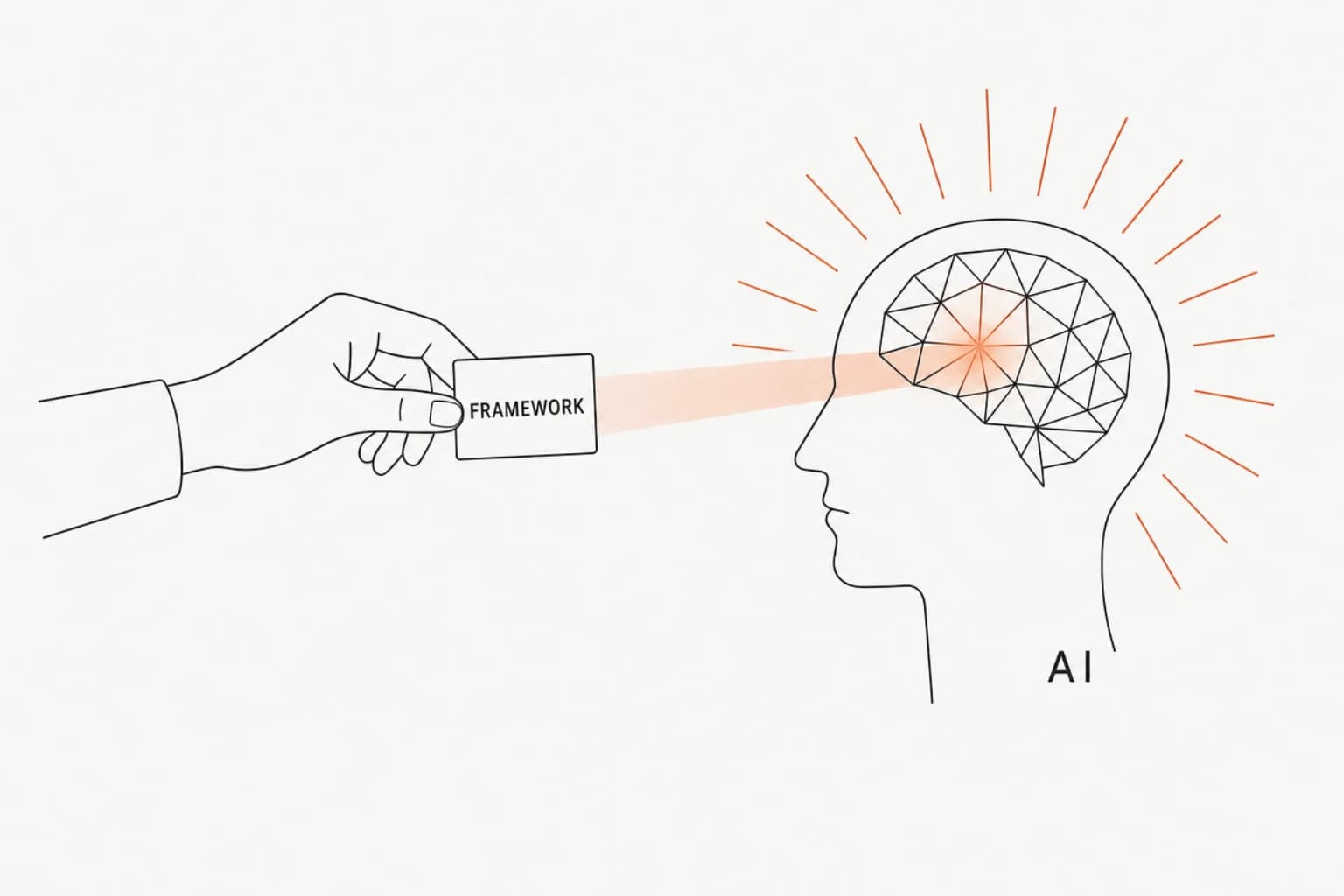
Why does AI give you mediocre answers? Because it knows everything, any specific piece of knowledge gets diluted. The solution is simple: tell it which mental models you have mastered. This article gives you a list of frameworks you can use right away.
The More Mental Models You Master, the More Useful AI Gets
Many people who use AI feel something is off: it always seems to be led by your questions. You ask, it answers. The answer is balanced and competent, but it rarely surfaces an angle you missed or walks you deeper into a problem on its own. It feels like a knowledgeable consultant who just waits for you to ask the next question.
Why is this? A common explanation is that the model isn't smart enough. I see it differently. A more accurate reason is that it has learned everything, but having learned something is not the same as being able to call upon it on demand.
We see the same thing in ourselves. We may have learned a pile of analytical frameworks and models, but after the final exam, most of the definitions are returned to the professor. The knowledge hasn't vanished; it has sunk into our intuition, becoming heavily diluted. When a new problem arises, you rarely stop and think, "Which framework should I apply here?" You mostly move forward based on a vague sense of direction.
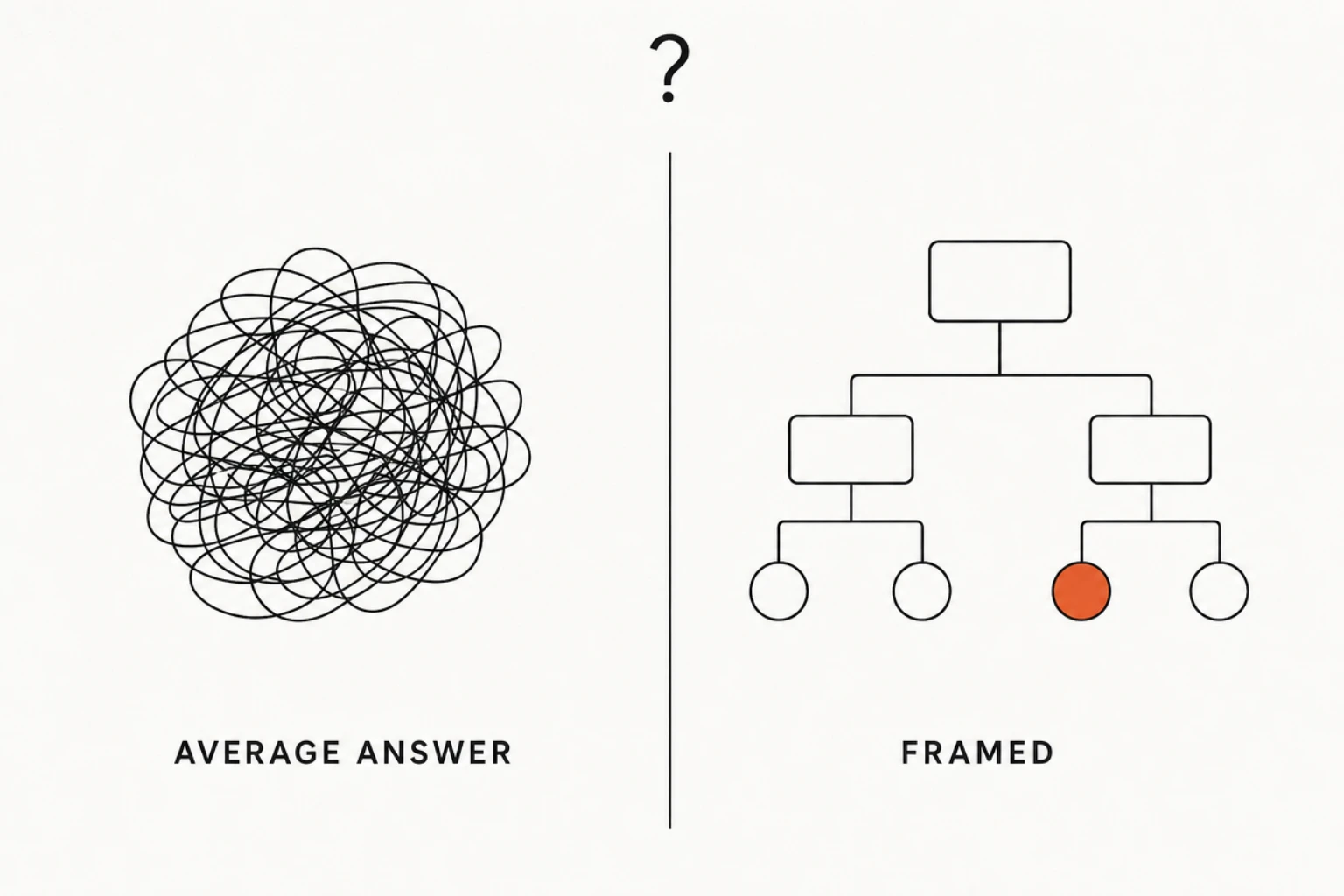
AI is the same, only more extreme. It is a brain that has learned nearly all of human knowledge, but precisely because it has learned everything, any single framework within it is diluted to almost nothing. If you don't specify one, it won't volunteer one. It will give you an average answer that covers all possible cases and is therefore useless for your specific case.
So I find myself using it this way more and more: instead of asking follow-up questions repeatedly, I just tell it which framework to use.
You can try it yourself. Take a real problem to an AI, like, "My online store isn't getting much business, what should I do?" It will give you a balanced answer: optimize keywords, use social media, take better product photos, run a promotion. Every point is correct; together, they say nothing.
Then, try asking differently. Explain your store's situation, and add at the end, "Please use the 'people, goods, field' framework to help me break down the root causes." The same model instantly changes. It will focus its attention on three dimensions: people (who your customer base is, where they come from, why they don't return), goods (whether the product and pricing are competitive), and field (the path from entering the store to placing an order, and where it gets stuck). The original "correct but useless" advice converges into a diagnostic map that points straight to the source of the problem.
This is the point I want to make: when it comes to the knowledge that has settled into our intuition, simply saying the name of the analytical framework is more effective than relying on intuition alone. Explicitly specifying a framework is an effective way to mobilize the AI and to awaken our own memory and intelligence. People and AI are the same in this regard: the knowledge is already there, what's missing is a clear instruction.
Why Specifying a Framework is So Effective
The reason isn't complicated. Both humans and models default to the path of least resistance, seeking a "most plausible" average answer. If you don't provide constraints, the AI will take the greatest common divisor from the thousands of "online store operations" articles it has read and give it back to you. That answer addresses all situations, and so it addresses none of them.
A framework's role is to provide a structure that blocks this default highway. It gives the model a skeleton, forcing it down a narrower, more specific path, making it fill its scattered information into one slot at a time. It's the same for people. When you specify a framework, the half-forgotten knowledge in your own head is reactivated, and you start to see the problem through that structure again.
Three Kinds of Things Worth Knowing
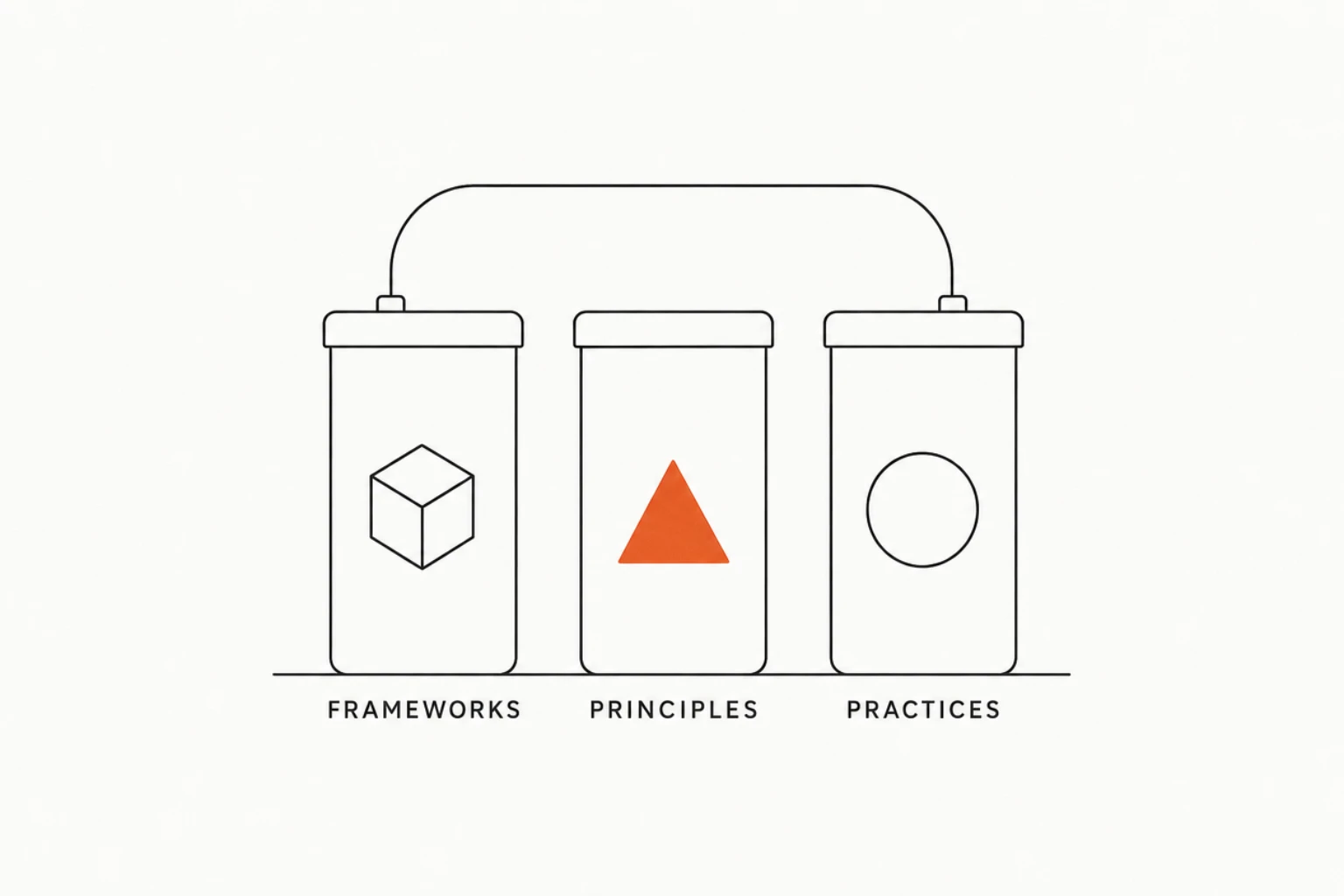
The things worth keeping in mind and telling an AI fall into roughly three categories. Thinking frameworks, for a one-time, structured breakdown of a problem. Principles, one-line rules you have to hold continuously rather than use once and put away. And work habits, practices for "how to do the work" itself. A framework gives you a single analysis, a principle gives you a continuous gravitational field, and a work habit decides how you start every time.
They also differ in value. Everyone knows SWOT. Tell an AI to use it, and you'll get back a generic answer that anyone could have gotten. What really creates a gap is the scarcer, deeper, more transferable knowledge. In my view, the most valuable batch comes from software engineering: this industry has spent decades wrestling with the most complex systems and has been forced to distill truths about complexity itself, which can be ported almost unchanged to other fields.
Below are the ones I use most often. For each, I'll only give an introduction; to truly understand them, click the "Read more" links—those pages explain them better than my few sentences can. You don't have to memorize them all. Pick a few that feel right, and remember to use them when a problem comes up.
Thinking Frameworks (for a one-time analysis)
MECE. Short for Mutually Exclusive, Collectively Exhaustive, this is an iron rule McKinsey consultants use to structure problems. When you split a big problem into pieces, the pieces must not overlap and, added together, must leave nothing out. Counter-example: splitting customers into "male / female / student" both overlaps (a student is male or female) and has gaps, so it looks complete but can't be used. Have an AI self-check these two conditions before it breaks something down and its categories come out much cleaner; without the reminder it often hands you a list that fights itself and misses a whole chunk. Read more: MECE principle.
Pyramid Principle. An expression framework from McKinsey's Barbara Minto: put the conclusion first, support it with a few groups of reasons, each of which can break down further, opening top-down like a pyramid. Its opposite is the failing most of us have, telling things in the order they happened, starting from background, talking for a long stretch before revealing the point. Ask an AI to organize a report or proposal as a pyramid and the reader grabs the point at a glance; without it you often reach halfway and still don't know what it's trying to say. Read more: Barbara Minto.
First Principles. The term comes from Aristotle: the most basic premise of a thing, one that can't be broken down further and needs no further proof. Thinking this way means peeling a problem down to those bottom premises and reasoning back up, instead of tweaking from the status quo and what peers are doing. When Musk figured out the cost of a rocket, he didn't look at what rockets sell for on the market; he asked what the metal and fuel to build one are actually worth. Ask an AI to start from "what is the most bedrock, undeniable constraint here" and it often steps around the inertia of "everyone does it this way." Read more: First principle.
Issue tree. Also called a logic tree: take a vague big question and branch it downward level by level, like a family tree, into smaller and more specific sub-questions, until each leaf is something you can directly verify or act on. "Why aren't we making money" splits into "why is revenue low" and "why are costs high," and each of those branches further. Ask an AI to build the tree before it answers and you get a map you can check item by item; otherwise you get a vague reflection and don't know where to start. Read more: Issue tree.
People, goods, field (人货场). A skeleton Alibaba introduced in "new retail," now common across Chinese e-commerce, that breaks a retail business into three elements: people (who the customers are, where traffic comes from), goods (the product itself, supply, pricing), and field (channels, scenarios, the path from seeing to ordering). Its value is forcing a vague anxiety like "business is bad" into a specific location. The online store earlier is exactly this: no orders, is the problem the people, the goods, or the field? This one has no standard English encyclopedia entry; it comes straight from the Chinese new-retail vocabulary.
Purchase funnel. Picture a conversion path as a funnel: a big batch enters at the top (sees the ad) and leaks out layer by layer (clicks, adds to cart, orders, repurchases), each layer smaller than the last. It stops you saying "conversion is bad" in the abstract and makes you look at which specific step is leaking. Ask an AI to lay out the retention rate of each step and you often find the problem stuck at one step, and that step is what to fix, not everything. Read more: Purchase funnel.
Lean MVP. MVP is Minimum Viable Product, from Eric Ries's The Lean Startup. The core: don't hold back a big all-in-one version, build the smallest version that just validates the core assumption, throw it at real users to see how they react, then decide to double down or turn around. It's the antidote to the "I think this idea is great" kind of self-indulgence. Ask an AI to compress a giant plan into "the smallest action testable this week, plus one clear assumption to validate" and it blocks you from plunging into months of speculation. Read more: Minimum viable product.
Combinatorial matrix and whitespace search. The formal name is morphological analysis, invented by the astronomer Fritz Zwicky. You lay the already-validated elements of a field along a few axes into a table, cross them into every combination, and hunt for the empty cell nobody has taken. Many hits are just new combinations of old elements; "sleep audio," for instance, can be laid out by theme, format, and language to find open cells. It forces you to search possibilities systematically instead of waiting for inspiration, and it works for topic selection, positioning, and finding differentiation. Read more: Morphological analysis.
7 Powers. In his book of the same name, the investor Hamilton Helmer sets out seven durable competitive advantages: scale economies, network effects, counter-positioning, switching costs, process power, branding, and a cornered resource. The keyword is durable: not a momentary lead, but an advantage a rival can't easily copy even when they see exactly what you're doing. Have an AI audit your business against these seven one by one, to see which you actually hold, and it lands far better than vague talk about a "moat." This one has no encyclopedia entry; see Hamilton Helmer's book 7 Powers: The Foundations of Business Strategy.
Cialdini's six principles of influence. In Influence, the psychologist Robert Cialdini set out six psychological switches that get people to say yes: reciprocity (you got a favor, you want to return it), commitment and consistency (you want to keep your word), social proof (everyone else is doing it, so you do too), authority, liking, and scarcity (running out makes it more wanted). When writing copy or designing a persuasion, have an AI go through the six asking "can one apply here," which is far more concrete than telling it to "make it more persuasive." Read more: Robert Cialdini.
Principles (a one-line rule you hold continuously)
Fail fast. A counter-intuitive engineering habit: rather than let a system carry an error and drag the problem until it blows up late, let it stop and report loudly the instant something is wrong, because the later an error surfaces, the more it costs to locate and fix. Applied to work, it means not papering over real failures with fallbacks and "looks fine." Have an AI hold this and it won't quietly swallow an exception and hand you a running illusion. The sooner the bad news, the cheaper. Read more: Fail-fast system.
Single Source of Truth (SSOT). One fact keeps one authoritative home; don't let it have a version in five different documents, because once there are multiple versions they eventually disagree and nobody knows which to trust. Have an AI hold it and it stops to flag whenever it finds a fact in several places, asking you to confirm which one counts, and you save a lot of "which one is authoritative" bickering. Read more: Single source of truth.
Name matches reality. When the meaning changes, the name has to change with it. This is very old; Confucius called it the rectification of names: if names are not correct, speech does not flow. It looks small, but it's my favorite, because its most extreme form is hidden in Hofstadter's Gödel, Escher, Bach. The book keeps circling strange loops and self-reference, and how many beautiful systems share an isomorphism, where form and content, macro and micro share one structure, self-similar layer within layer, which is recursion. Someone built these ideas into a "fractal document system": code is one facet for machines, docs another for humans and AI, the two facets have to line up, and once name and reality diverge, the work isn't done. A plainer example everyone gets is naming. The name you give a company or product is never just a label; it's a shaping of the reality, and through an invisible loop it feeds back on where the thing grows. A fund called "Long-Term Capital Management" writes its self-positioning into its name, attracts a certain kind of investor, and gives the founders one more check against temptation; a company with an overly down-to-earth, folksy name that later wants to move upmarket finds the name a burden it can't shed. So hand this to an AI and let it audit product names, project names, even a document's title and structure, and it helps you catch the small cracks where name and reality don't match and will eventually break. (The fractal document system itself goes far deeper than this; if you're curious, see chunxiang.space/geb-system.) Read more: Rectification of names, Gödel, Escher, Bach.
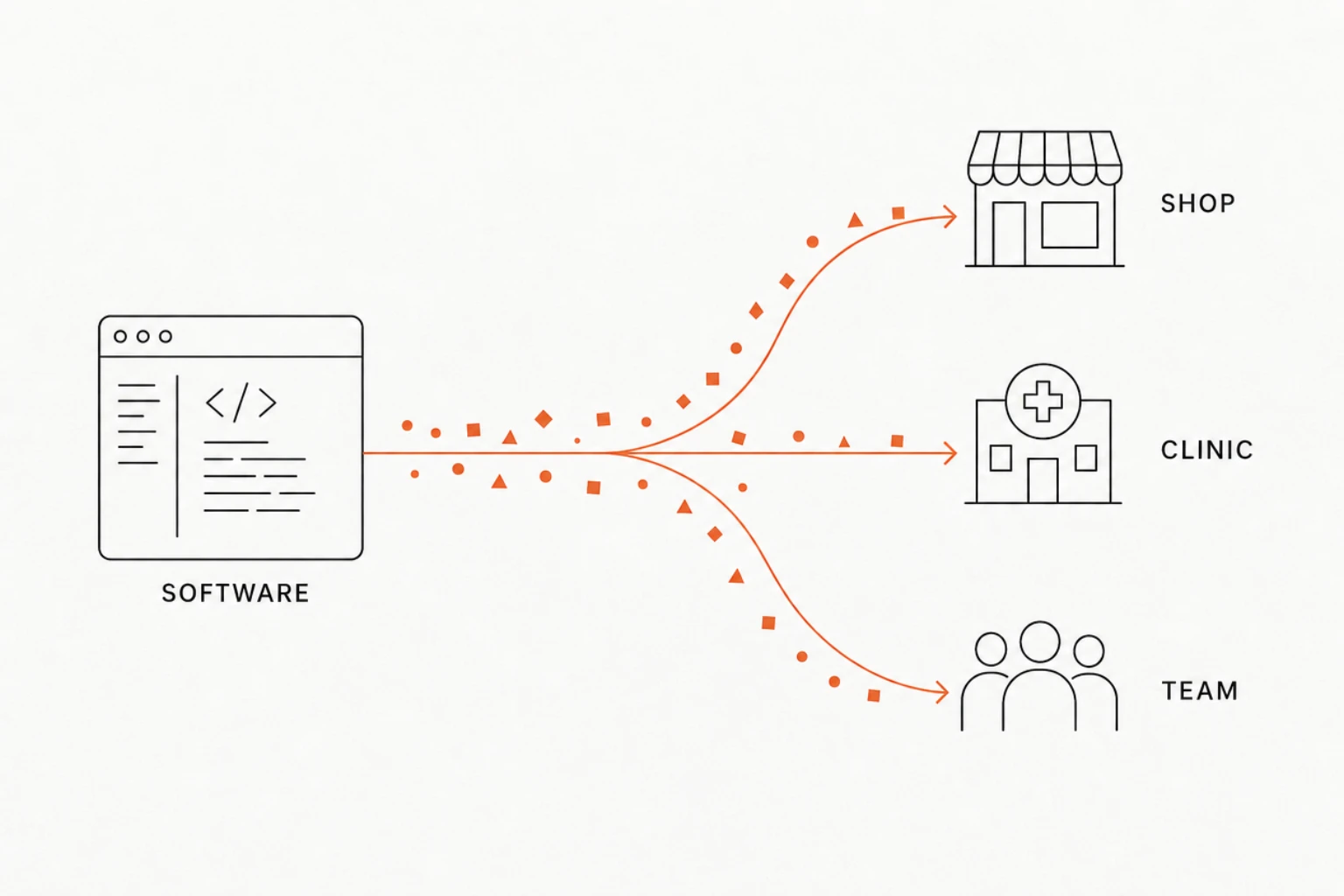
Brooks's Law. From the software classic The Mythical Man-Month: adding people to an already-late project only makes it later, because new people need time to ramp up and old hands spend time bringing them up, and the more people there are, the more communication links run between them (growing roughly with the square of headcount), which quickly overwhelms the extra capacity. This isn't only about code. A shop that can't keep up and doubles its kitchen staff on the fly usually just gets a messier kitchen. Have an AI keep it in mind and its "add people to go faster" plans weigh the communication overhead first. Read more: Brooks's law.
No Silver Bullet. Also from The Mythical Man-Month. The silver bullet is the legendary one bullet that kills a werewolf; here it means "one trick that solves every problem." The author's judgment: some of software's complexity is inherent to the problem and can't be removed (essential complexity), some you brought on yourself with clumsy tools and bad process (accidental complexity); tools can kill the latter but do nothing for the former. A doctor's diagnostic difficulty is essential; handwriting records and running around for stamps is accidental. AI is especially good at clearing accidental complexity, but holding this, you won't naively expect it to one-click away the essential difficulty. Read more: No Silver Bullet.
Conway's Law. The system an organization builds ends up shaped like the organization's communication structure. Plainly, two departments that barely talk will likely produce two modules that don't fit together. The thicker the department walls, the more the product fractures into pieces that each speak their own language. It's more interesting used in reverse: to change the shape of the product, you often have to change the shape of the org's communication first. Read more: Conway's law.
Technical debt. A shortcut taken for a quick win is like taking out a loan. You save effort now, and later you pay back principal plus interest, the interest being that it makes every later step harder to change. The metaphor stretches to almost every "borrowing" in life: pulling all-nighters is borrowing against your health, dodging a hard conversation into a cold war is borrowing against the relationship. Have an AI mark which kind of debt a plan is taking on and how high the interest is, instead of only eyeing what you save right now. Read more: Technical debt.
Work Habits (how to start)
Find a benchmark, search the methodology first. Before you start, default to "someone has probably done this." Benchmarking means first finding a strong example, measuring the gap, then deciding how to do your own. Have an AI find benchmarks, existing methodologies, and public frameworks first, take a sixty-out-of-a-hundred baseline and iterate up, instead of grinding from zero against a blank page. Most of the time, the starting point shouldn't be blank. Read more: Benchmarking.
Do a retro, harden the steps. When something's done, don't rush to turn the page. Spend a few minutes going back over it: which step could improve, which repeated manual action could harden into a checklist or template. This is what the Japanese call kaizen, continuous improvement, compounding through small increments. Have an AI do this retro with you and the next similar task is faster, which is exactly what this article argues: settle the useful stuff so you can call it up again anytime. Read more: Kaizen.
How to Use: Write These Into Your Standing Instructions
With so many frameworks and principles, how do you actually use them?
My recommendation is to ground them in your own workflow, not to go diagnose and re-engineer an organization. To be frank, these ideas are more the result of research and reasoning than battle-tested at an organizational scale, a point I must make clear.
The simplest and most effective approach is to write the few that matter most to you directly into the standing instructions you give your AI. In my own default instruction file for Claude (CLAUDE.md), I have a few permanent lines: uphold SSOT, and if you find a piece of information has multiple sources, stop and ask me to confirm which one is authoritative; for any proposal, follow up with its trade-offs and don't just report the good news; do not speak in generalities until I have given you a concrete example. Once written, the AI changes from a PhD who answers any question into a partner that thinks on my behalf using my methodology, and I don't have to remind it every time.
If you want to do the same, the easiest first step is to copy the following block to your AI:
Please read the article I've given you, then help me revise my
CLAUDE.md/AGENTS.md(AI standing instructions file) to incorporate its methods:
- When I ask you an analysis or decision-making question, proactively determine if a suitable thinking framework (e.g., MECE, people-goods-field, purchase funnel, first principles, 7 Powers, etc.) can be applied. If so, use it to structure your answer instead of giving me a generic, all-encompassing reply. When necessary, proactively ask me for missing information.
- Always adhere to these principles: fail fast, Single Source of Truth (SSOT), name matches reality, no silver bullet (distinguish essential vs. accidental complexity), and awareness of technical debt.
- Before starting a task, help me find benchmarks and search for existing methodologies. After completion, help me conduct a retro and solidify reusable steps into a checklist.
After you've made the changes, list the paragraphs you added or modified for my confirmation.
In Closing
Knowledge is being completely flattened. Any fact, any concept, is one question away. But this doesn't mean judgment is worthless. Quite the opposite.
AI has erased the cost of acquiring "knowledge points" for everyone, but in doing so, it has highlighted something else: whether you can mobilize "knowledge structures," and how quickly and accurately you can do it. The same model is available to everyone. Some can only extract correct but useless average answers. Others can name one framework after another and get it to produce something real. The difference isn't the model. It's the person using the model, and how much they have in their head.
This, perhaps, is where people will truly pull apart in the age of AI.